Soar Valley Light:110454 wrote:This 'standardised' type of signalling appears (to me) to have developed into this form around the turn of the twentieth century, possibly a little earlier. This, by chance, seems to have been roughly co-incident with the Light Railways act which (as previously stated in this topic) relieved minor railways of the need to signal at all in many circumstances.
I think you're about 30 years out, TBH. The Southwold is a little anomaly, as it was a 'light railway' before the light railways act that we all know about - there was some precursor legislation that allowed light railways of a form to be built. The only contractor that I can remember doing this is Arthur Pain who was the contractor for the Southwold. in fact it was <tippetty-tap> the Regulation of Railways Act of 1868 included provisions for railways to be constructed as light railways. Such railways could be constructed more lightly than normally required but incurred a maximum axle loading of 8 tons and a maximum speed limit of 25 mph. Arthur Pain, the engineer of the Southwold, was perhaps the main proponent of such light railways and very few were constructed, not least because an expensive Act of Parliament was still required.
Soar Valley Light:110454 wrote:All this means that the more extensively signalled narrow gauge locations would be using signalling equipment of a much earlier generation. This is clearly illustrated in this topic by the pictures of the Southwold and by MdeC's excellent signalling diagrams of Port. The difference in type, standard, meaning and use of such signalling, not to mention it's means of operation, thus seem almost to be a different animal.
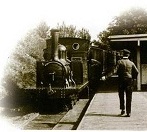
Yes; partly. Thus far you've had in the discussion the Southwold and the Festiniog. Now, the Southwold was constructed in 1879 as a 'lighter' railway, the Festiniog was constructed in 1832 as a horse tramway and converted to a passenger line in 1863/4. It is actually sheer coincidence that both railways have double arm semaphores.
If we begin with the FR, it was signalled to the contemporary standards of the early 1860s, and by the time the signalling fell into desuetude in 1926 I suggest that the surviving double arm semaphores (Port, Minffordd, TyB and TyG) were the last 'block' semaphores left in the UK that were not at a stopping point. By the time TyB opened and Minffordd was constructed (1871-4) the signalling system was already old hat - separate signals were provided at stopping points. The shape of Distants were very much a moveable feast - the FR stuck with the Disc signals until the end of signalling, although [and this is axiomatic to any understanding of FR signalling, in the majority of cases after the introduction of the 1876 rulebook (which was still largely in force until the (a guess) early 1930s)] the Discs were *not* Distants - they were 'Auxiliaries' (an old term for outer homes) or Stop signals. Trust me on this, it's something that really confused Boyd. i could go into at length, but the arcana of Festiniog signalling is an acquired taste.
However, if you'll indulge me a little longer on the FR, you may find this interesting. Take a look at this proposal for Portmadoc:

Now, this isn't the only proposal for resignalling Portmadoc at the time of the 1879/1880 rebuilding, but if you look at the style of the signalling, it is much the same as you would find on any pregrouping railway in the UK mainland up until about the time of the Great War.
Now, you may be wondering why the 'old' style signalling survived at Portmadoc until 1921 and what caused the FR to change its signalling style? In truth I'm not sure what happened at Port, as this tender was accepted, but never enacted. The second part is a bit more complex, and FWIW, the real reason is only just becoming clear - the fashions were not directly related to the Regulation of Railways Act of 1889 after Armagh, as some have thought. It was a far more interesting reason.
Many of you, I'm sure will be well aware of the vast plans for the North Wales Narrow Gauge Railways, that came to naught and were only embodied in the Moel Tryfan undertaking. There was also another pair of plans (ignoring the Merionethshire Railway for the present, as that didn't really take on a tangible form at all) - there were the Bala and Festiniog Railway and the Bettws-y-Coed and Festiniog Railway. Both were predominantly promoted by the rival standard gauge companies - the B&F by the GWR and the earlier ByC&FR by the LNWR. I have plans for both of these sat by my machine and if both had been built, the signalling of the Duffws branch would have been fantastic. The B&F was largely on the course of the F&B, which as we all know was regauged in 1883 *but* there was a plan for the B&F to continue up as far as Rhiwbryfdir! Now, don't forget that the LNW were planning to come south with a 2' line, broadly on the course of the later standard gauge: this was planned as early as 1873/1874 - the Bala and Festiniog was a direct competitor - so imagine if you can the FR lines in Blaenau, with a 2' gauge line coming in from the North and and another coming in from the East.
So? What's this got to do with signalling. Well, although the FR had gone to Parliament in 1869 to double track, very little had actually taken place. I'm currently unpicking the signalling history from Old Dinas Junction eastwards towards Duffws, and trying to actually pin down a date of when the second track was laid - be it throughout or piecemeal is quite difficult. The only certainty is that the was a bridge built (Church Street) for the Portmadoc and Beaver Pool turnpike in 1875 and in 1870 Duffws station was rebuilt into the form that is now preserved as public loos.
Cutting a very complicated story short: what is clear from the plans of the B&F is that they wanted their own right of way around the FR towards Rhiwbryfdir, crossing over the FR somewhere near the later LNW exchange station and the level crossing at Glanypwll, according to the 1873 plans. The ByC&F coming in from the North adopted a different strategy: in 1871/2 it was originally planned to terminate below Rhiwbryfdir Fields, but in 1874 the drive changed and there was going to be a big terminus on the site of the later North Western Hotel with a branch and junction towards the Festiniog terminus at Duffws.
This is the game-changer with FR signalling. Unlike the Festiniog and Blaenau this would have taken both goods and highly likely to have had passenger traffic from Duffws to Bettws. The FR Board discussed running powers at some length. The F&B junction (christened by Boyd to be 'Dolgarreg-ddu' Junction) was only ever for goods traffic, and as such the existing FR signalling could cope, with the Disc signal outside Duffws moving down the line to protect the junction (I have the plans sat next to this machine) but the existing FR signalling could not cope with an inspection from the Ministry if passenger traffic were to use the new junction both ways. A lot had changed with signalling even in the short period from 1868 when the F&B arrived to 1874 when the LNW were pushing southwards.
Although I have not yet found (and nor do I expect to find) a signalling diagram for the upper junction (ByC&FR/FR junction) it is this discussion of running powers that will have put proper signalling in the minds of the Directors. The earliest full signalling plan I can find for the area is dated December 1877 and that is semaphores everywhere - by 1879 the 'middle' bit of the Duffws branch would have been not only doubled (the Board discussed this in the summer of 1874) but the signalbox that later became Blaenau No 2 would have been in situ. Although in the end it came to naught, the FR's hand would have been forced by the desire of the ByC&FR to run into Duffws - This is I suspect part of the delay between the rebuilding of Duffws station into distinctly separate parts called the 'Goods Station' and 'Passenger Station' in 1870 and the eventual doubling during 1875 - the FR board were waiting to see what (in effect) the LNW and GW were actually going to do. All the traffic being handled out of Duffws on a single line would have caused an incredible bottleneck. I feel that this is the explanation for why there was 'conventional' signalling east of and including Old Dinas Junction.
The Portmadoc signalling plan is very much in the vogue of the time and I offer it as a counterpoint to the 1921 diagram, and it would be a pleasant exercise to work out what would have happened at Blaenau, but we must be chary of creating false history.
Soar Valley Light:110454 wrote:This is turning out to be a far wider ranging topic than I ever imagined would be the case. Having made some fairly sweeping and wide open comments here I shall await the volley of brickbats which I expect will be heading my way shortly!
Moving away from the FR, it would be instructive to look at 'proper' light railways, and their signalling, constructed under the 1896 Act. You might be in for a pleasant surprise, a couple of examples.
Both of these are ostensibly the same, though with the addition of a siding at one. It would have been more germane to use Capel Bangor as one of the examples, as like Castle Caereinion there were summer and winter frames. However, Capel Bangor had economic locks and that can confuse the unwary, so I've decided to use Aberffrwd instead. These two installations are nearly contemporary, but there are important stylistic differences, probably due to the fact that Castle Caereinion was manned irregularly. However, they were both later additions to the original railway: Aberffrwdd in 1904 and Castle Caereinion in 1907.


Aberffrwdd was going to be regularly used to cross a pair of passenger trains, so had starting signals, but no signalbox. Castle Caereinion was to be used for a couple of months at a time and otherwise the groundframes would be used unless there was a crossing between a passenger and a timber train. As a result, Castle had Distants, but no Starters and did have a signalbox. Consistency, eh?




 you are too kind. but as a bonus, I offer another drawing at the end which has commonalities with the Southwold arrangements.




 Including signalling schemes that were never implemented.