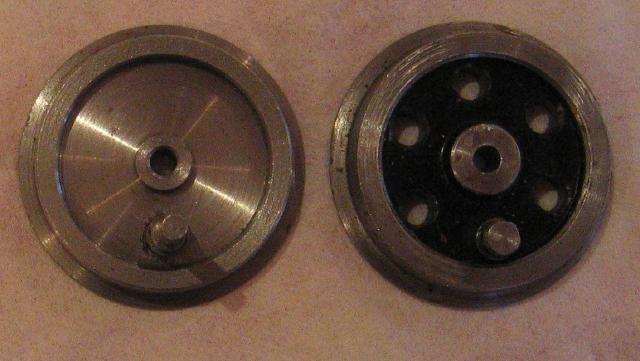


The different punches used on the crank pins, Mamod (red) on the left, MSS (black) on the right.
The wheels were/are probably pressed onto the shaft using a 3 or 4 splined punch press which is the main weakness of these wheels as they work loose (particularly the leading axle which is powered by the pistons) - both the Mamod & MSS wheels suffer from this problem (I've heard of an MSS wheel completely falling off an axle shortly after it's owner starting running it in).

An unfinished Mamod wheel casting on the left, and the punched steel shaft on the right.
The loose wheels can be fixed with some success. I have found it is very difficult to find a suitable shaped punch to just punch the shafts back into the wheels, and the harder you drive that punch the more you risk bending the steel axle. So I use a set of mole grips to hold the centre of the axle and gentling prise off the loose wheels. After re-punching the coupling crank pins as necessary (the leading axle crank pin needs to be supported in a vice or similar so that it does not bend when punched), I roughen up the end of the axles with coarse sandpaper. Having tried epoxy and various super glues, following a good recommendation, I’m now a convert of using Loctite 603 to fix the wheels back onto the axle, making sure you have set up the correct 90 degrees crank pin offset.
Another problem with the Mamod/MSS wheels is they have a small tread and being made from Mazak are quite light so this opened up an after market for replacement steel wheels. There were/are several different styles produced, and hopefully other Members can add their experience here for types I have not included.
MGM Engineering – This company offered a service where the original Mamod wheels were pressed onto replacement steel axles and the chassis frames were punched to hold the brass axle bearings in place (another weakness of the Mamod/MSS design as the bearings are free to rotate in the chassis frames, and also are a loose fit so allow some sideways movement as well – I now use Araldite Rapid Steel epoxy to hold these bearings in place).

MGM Engineering reworked Mamod wheels.
I’m experimenting with a set of Mamod wheels which have been Loctite 603’d to a replacement 5/32” steel axle.
Unknown Maker – These spoked steels wheels were fitted to a modified SL1K I obtained. The front crank pins were long 8BA screws which had a small hole drilled through them for a locking pin. That was their weakness and both screws fractured as the pistons were seized.

The unknown maker Mamod wheels.
A new crank pin for the front wheels with an 8BA threaded stud would make these wheels usable again – sadly that’s above my current limited workshop tools and skills.
IP Engineering – Originally they produced a set of holed disk steel wheels which were used in the IP Jane and also for Mamod & MSS upgrades. These used a tight fitting bearing which was held into the chassis frames by nuts. However these needed to be aligned correctly for free running, and indeed it was recommended to shorten the Mamod/MSS chassis spacer to help (the IP Eng Meths Burner spacer is shorter than the Mamod/MSS one).

IP Eng holed disk wheels fitted to an IP Jane (coupling rods were supplied unpainted).

Showing the style of bearings used by IP Eng.
Towards the end of IP Eng Mamod upgrades these wheels became plain steel disks instead. In use these wheels can work loose but Loctite 603 will fix them back onto the axles. IP Eng also produced a replacement coupling rod which is of a light weight steel thus easily bent – in use I have found I have had to ream out the holes for the coupling rod pins otherwise they can lock the wheels up.
Dream Steam – Originally set up from the sale of the IP Eng Mamod upgrades their recent plain steel wheels have suffered from quality control problems.

An early set of Dream Steam wheels (possibly old IP Eng stock), together with a Peter Jones Loco Works wheel insert.
I have a 2nd pair where the size of the nuts used to hold the bearings into the chassis frames is different on each axle (needing another spanner or an adjustable), and I’ve seen a set of 45mm wheels which had too small spacers added allowing too much sideways play. Like the IP Eng steel wheels they can also work loose.
PPS Steam – Originally they produced a set of plain steel wheels (same as the IP Eng ones), and then followed up with a set of spoked wheels which use a similar style of loose brass bearing as fitted to the Mamod/MSS wheels. Again the plain steel wheels have been reported as working loose.

PPS plain steel wheels (note the rust!).

PPS spoked steel wheels.
Roy Wood Models – Set up from the sale of the PPS stock, Roy offers the plain steel wheels and the spoked wheels. He has also produced a new style of coupling rod, and again I’ve had to ream out the holes to fit a set of IP Eng holed disk wheels (seems there are slight variations in the diameter of crank pins used between the various wheels).
One problem with the steel wheels is they do rust in use, particularly the plain steel wheels which are unpainted. They also look rather boring with those plain disks. Inserts were produced for a short time by Alan Briggs until he had to make a rather rapid exit from the industry, and a new alternative may be available from the Peter Jones Loco Works.

A Peter Jones Loco Works wheel insert. Due to the variation is sizes of the machined steel wheel disks Peter has made these slightly oversize so they can be sanded/filed down to the right size for a tight friction fit (this one needs a bit more work yet).
Hopefully other Members will be able to add some more information to this Topic.
Chris Cairns.