
I've read about slopes, minimum radius, tracks, plants, buildings, you name it. Slope is easy: 0%. Plants are a bit harder, I prefer them dead (If only the Chinese could make lifelike, durable, plastic outdoor plants.
 ) and scenery like building etc. aren't of any concern yet.
So I'm going to flood you with questions about tracks. But, before that I'm going to explain the situation with pictures. Not that pictures are necessary, but it has been proven that pictures make an otherwise boring topic a bit less boring.
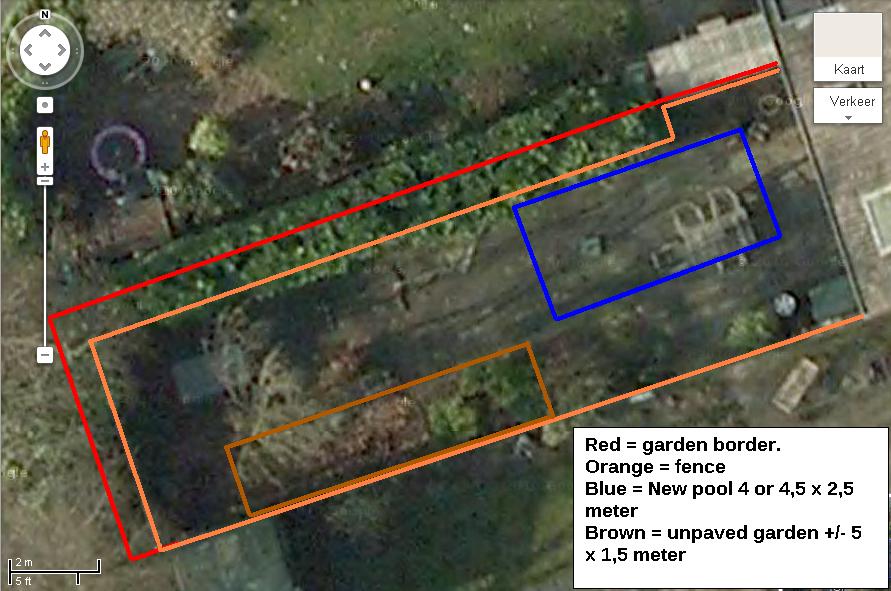
Copyright by Google maps, but since it's my garden: to hell with their copyright!
A not very accurately drawn "situation" in my garden. (The garden is 6,5 meters wide and a whole lot of meters long.) I'm planning to use the flower bed. I can extend it to about 10 meters long towards the back of the garden and make it about 2 meters wide without having to cut a whole lot of tiles. (the tiles are laid in a pattern)
I'm planning to make a track with a curve radius of 85cm, (about 2ft 9,5 inch) in theory that should be wide enough, but is it? I'm only going to run narrow gauge live steam locos and I rather not encounter a situation in which a new bought loco or carriage won't run on my track! (This was the first question.)
Second question: I took a 85cm radius because in Anyrail that's exactly 3 pieces of Peco flexi tracks which is very convenient. How accurately is Anyrail? I of course don't want to figure out the hard way that the track I had envisioned and drawn in Anyrail is totally different in the real world.
Third question: Is it even possible to lay a track with a radius of 85cm on a space about 2 meters wide? How much space is recommended between the centerline of the track and obstacles? It would be a shame if a new bought loco, wider than my Mamod, would run into the fence etc.
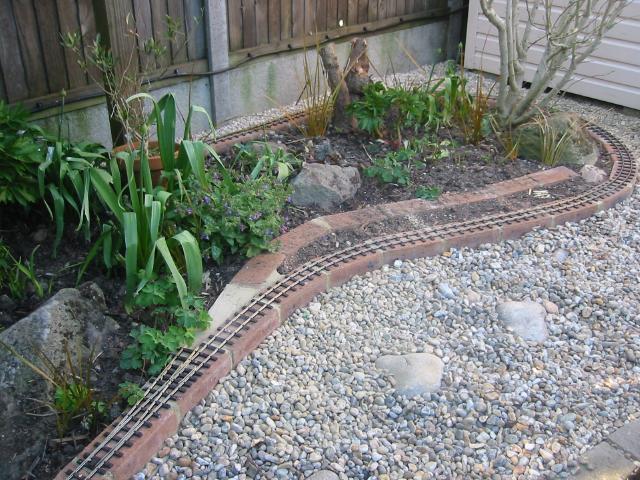
At the moment the reserved space is a bit of a mess, I tried to make a panorama photo, but that didn't work out quite well so two pictures.

Left. The first row of tiles are easily removed, which makes my space about 2 meters wide.
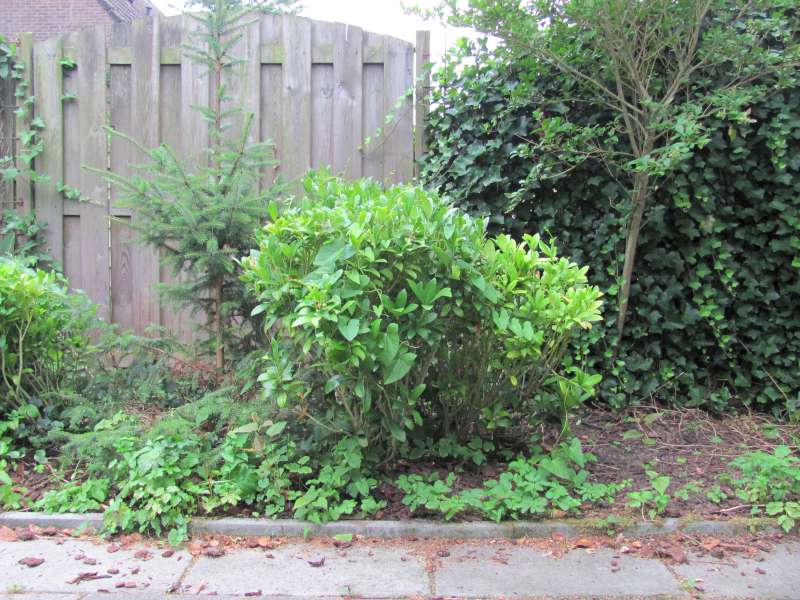
Right. (The other meters not shown in the picture are paved so of no concern.)
On the left is a small waterfall hidden. It's going to stay, but I'm planning to extend it with a canal to a small harbour with a pump circulating the water. This has two benefits: I can have a tunnel and bridges without raising the track. And, I'm Dutch, the Dutch like messing around with water. Give a Dutchman a plastic bucket and shovel at the beach and instead of building a sand castle he's going to build a dyke to hold back the sea!
On the right is my christmas tree, that one has to stay. On the far right all is quite dead already. My wifes dog loves to dig and roll in the dirt. Not too convenient for a garden railway, but to keep neighbours cats out I'll probably install a few high voltage wires around the railway anyway, so that solves two problems.
That brings me to the fourth question: Points! A railway needs points, but since I'm going to run live steam locos shunting isn't something I'll be doing. Maybe in a far future when I can control my loco(s) without having to run after them, but definitely not at this moment. I tried to find some live steam narrow gauge layouts, but most garden railwayers seem to only take pictures of parts of the track which is understandable, it looks nicer than an "aerial photo" showing the whole track, but it definitely doesn't help getting an idea how others (who also are limited in the width) designed their live steam narrow gauge railway.
And that brings me to the fifth question: designing a railway. I'm planning to dig in cemented bricks and bolt the track to the bricks with a mixture of cement and small stones as railway bed. In other words: if the track lays in place it stays in place, which makes it hard to alter the railway afterwards. Peco flexi rails seems not to be very flexible when you want to alter your railway so adding points afterwards is going to be a pain in the ***, but buying all track at once will be a very costly afair. I'm unfortunately not in the position to spend hundreds of pounds at once. So how do you guys (and girls) handle this problem?
I guess these are enough questions for one topic.