forgive my ignorance, but what two scales are we looking at here?laurence703:84388 wrote:A postcard from North Wales... Visiting motive power to the Wigfa and Llanrwst Railway.
A question of scales
-
mightymax

-
Resurgam05
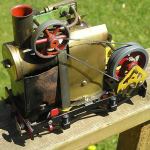
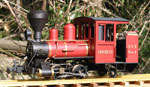
Hi mightymax, both locos are 16mm scale; in this case running on 32mm gauge track representing 2ft gauge. One is a much modified 'Mamod' (green), the other is an Accucraft 'Caradoc' (red).
It is simply that the 'Caradoc' is a much bigger loco compared to the Mamod; think putting a small 'Quarry Hunslet' alongside say Karen or Gelert from the WHHR.
It is simply that the 'Caradoc' is a much bigger loco compared to the Mamod; think putting a small 'Quarry Hunslet' alongside say Karen or Gelert from the WHHR.
-
Chris Cairns
- Driver

- Posts: 2372
- Joined: Mon Oct 29, 2007 7:25 pm
- Location: Glasgow, Scotland

-
Resurgam05
(Perhaps one of the mods might like to move this to a more suitable area to avoid bungling the thread.)
Whilst Mamods could generally be considered closer to 14mm scale; I did qualify my comment of 16mm scale regarding the two locos in this picture by saying, "running on 32mm gauge track representing 2ft gauge".
(Laurence: If you consider Ofario and/or Wolverton to be any other scale than 16mm:1ft, I will happily stand corrected.)
Whilst Mamods could generally be considered closer to 14mm scale; I did qualify my comment of 16mm scale regarding the two locos in this picture by saying, "running on 32mm gauge track representing 2ft gauge".
(Laurence: If you consider Ofario and/or Wolverton to be any other scale than 16mm:1ft, I will happily stand corrected.)
-
laurence703
Scale is not what I go by to be honest... If it looks right then that's what matters... But whilst on the subject of scale, the caradoc is over scale I think... I think of my locos as the small quarry branch loco or light passenger loco and the big heavy passenger / freight loco... But even then I run them with anything!
I agree resurgam... Think we need a new thread... It's a question of scale...
I agree resurgam... Think we need a new thread... It's a question of scale...
-
Resurgam05
-
DolwyddelanLightRail

-
Chris Cairns
- Driver
- Posts: 2372
- Joined: Mon Oct 29, 2007 7:25 pm
- Location: Glasgow, Scotland
Scale gets confusing when you are comparing freelance designs of non-prototypical locomotives as in the case here of the MSS (the modern re-engineered version of the Mamod SL locomotive which was a toy that was quickly adopted by the Garden Railway community as it offered an entry level live steam locomotive at a bargain price, which still equally applies to the next generation of 16 millers as displayed throughout this Forum) and the Accucraft Caradoc.
I agree that the Caradoc (and other freelance designs that Accucraft have sold over the years) is somewhat large for 32mm, as it has a internally fired central flue boiler, and gauge adjustable wheels and valve gear requiring a wider chassis compared to the external pot boiler oscillating Mamod/MSS which was only available in either 32mm or 45mm (not dual gauge as wheels are mounted outboard of chassis frames hence thinner chassis).
Just to add to the confusion take Laurence's 32mm Binnie Engineering Hudson Tippers. The 45mm version does not just fit wider wheels but needs a wider chassis as well, yet I believe it still uses the same size tipper bucket. So that bucket can only surely be "in scale" for either the 32mm 2' gauge system or the 45mm 2' 9 & 3/4" gauge system, but not both? It does mean that you need to be careful with rolling stock dimensions if you want them to match your locomotive to 'look right' - just look at all the different proportioned rolling stock that IP Engineering has produced over the years to cater for these different size locomotives.
Chris Cairns.
I agree that the Caradoc (and other freelance designs that Accucraft have sold over the years) is somewhat large for 32mm, as it has a internally fired central flue boiler, and gauge adjustable wheels and valve gear requiring a wider chassis compared to the external pot boiler oscillating Mamod/MSS which was only available in either 32mm or 45mm (not dual gauge as wheels are mounted outboard of chassis frames hence thinner chassis).
Just to add to the confusion take Laurence's 32mm Binnie Engineering Hudson Tippers. The 45mm version does not just fit wider wheels but needs a wider chassis as well, yet I believe it still uses the same size tipper bucket. So that bucket can only surely be "in scale" for either the 32mm 2' gauge system or the 45mm 2' 9 & 3/4" gauge system, but not both? It does mean that you need to be careful with rolling stock dimensions if you want them to match your locomotive to 'look right' - just look at all the different proportioned rolling stock that IP Engineering has produced over the years to cater for these different size locomotives.
Chris Cairns.
-
laurence703
I think that's partly to do with keeping the cost of materials down in the case of the tipper bucket, but also in full size practice no two railways used the same loading gauge (with exceptions) due to the surroundings or a few limiting factors which ultimately influenced the design of the locos and rolling stock.
Therefore the coaches, wagons, locos etc could be true 16mm scale but have a larger loading gauge... bit like comparing the Ffestiniog's coaches to those of the Leighton Buzzard NGR, both railways have limiting factors and yet when modelled to scale, will be very different in size.
Freelance locos such as the Caradoc are huge for 16mm, yes but to meet this problem IP Engineering has made a set of coaches that match the massive size of the loco to make it look right as it dwarfed about everything else.
Therefore the coaches, wagons, locos etc could be true 16mm scale but have a larger loading gauge... bit like comparing the Ffestiniog's coaches to those of the Leighton Buzzard NGR, both railways have limiting factors and yet when modelled to scale, will be very different in size.
Freelance locos such as the Caradoc are huge for 16mm, yes but to meet this problem IP Engineering has made a set of coaches that match the massive size of the loco to make it look right as it dwarfed about everything else.
-
GTB
- Driver
- Posts: 1719
- Joined: Sat Mar 05, 2011 2:46 pm
- Location: Australia
Hudson tippers aren't a good example in this case as they are rated by volume. A 1 cubic yard tipper on 2' gauge is still a 1cubic yard tipper on 3' gauge, the only difference will be in how the frames are arranged. The Binnie skip is I think, based on the Hudson Rugga 27 cu.ft. design whic was available in a range of gauges from 18" to 30".Chris Cairns:85989 wrote: Just to add to the confusion take Laurence's 32mm Binnie Engineering Hudson Tippers. The 45mm version does not just fit wider wheels but needs a wider chassis as well, yet I believe it still uses the same size tipper bucket. So that bucket can only surely be "in scale" for either the 32mm 2' gauge system or the 45mm 2' 9 & 3/4" gauge system, but not both?
In 16mm/ft scale, the Mamod/MSS is bigger than a 2' gauge Groudle Glen loco., but there are a lot larger locos. running around on 2' gauge. The Accucraft freelance locos. are only large by UK 2' gauge standards and would be at home on a lot of colonial 2' gauge railways.
To be pedantic a freelance miniature loco. has no scale, it is the full size original.................

Regards,
Graeme
-
GardenRail
Compare it with Karen!! this loco is significantly bigger and indeed one of these has been ordered for my own railwaylaurence703:85983 wrote:Scale is not what I go by to be honest... If it looks right then that's what matters... But whilst on the subject of scale, the caradoc is over scale I think... I think of my locos as the small quarry branch loco or light passenger loco and the big heavy passenger / freight loco... But even then I run them with anything!
I agree resurgam... Think we need a new thread... It's a question of scale...

-
GardenRail
-
Resurgam05
Given my 1:1 narrow gauge railway background I am given to liking 2ft(ish) gauge locos of all sizes hence 16mm scale on 32mm is my personal choice; but I do have a particular fondness for the extreme ends of the spectrum...

By means of comparison, here is one of the largest commercially produced 16mm locos based on a nominal 2ft Gauge prototype, compared with one of the smaller types.
By means of comparison, here is one of the largest commercially produced 16mm locos based on a nominal 2ft Gauge prototype, compared with one of the smaller types.
-
IrishPeter
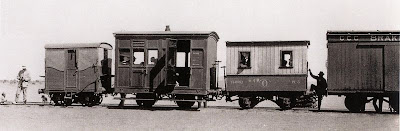
As my screen name suggests I favour Irish 3' Gauge. This means I am working in 15mm, rather than 16mm, scale. This means that some equipment is a little wide for me. Unofficially, the Skebawn and Castleknox can handle anything up to 105mm wide, and 165mm tall - which is 7' by 11' full size, but most of my stock is smaller than that, which means my "brig-holes' are 165mm by 180mm minimum. However, right now there are no over bridges.
For most of my equipment I aim for 97mm wide and 143mm tall, 6'6" by 9'6", which is roughly the envelope used by the Ballymena and Larne's older stock, the Castlederg Tramway, and the Skull and Skibbereen, This is because most Victorian era lines did not build out to the limits of the structural envelope. The widest vehicle is No.10 the brake van which is 125mm over the lookouts, and the tallest No. 8 which is exactly 150mm.
Peter in AZ
For most of my equipment I aim for 97mm wide and 143mm tall, 6'6" by 9'6", which is roughly the envelope used by the Ballymena and Larne's older stock, the Castlederg Tramway, and the Skull and Skibbereen, This is because most Victorian era lines did not build out to the limits of the structural envelope. The widest vehicle is No.10 the brake van which is 125mm over the lookouts, and the tallest No. 8 which is exactly 150mm.
Peter in AZ


Who is online
Users browsing this forum: No registered users and 24 guests