Track commissioning work continues, in spite of the local climate........
The weekend was wet and miserable, so the time was spent in the workshop making some new parts for the point levers. The original design worked fine, but didn't have enough throw and a few wheel sets that were slightly narrow back to back were hitting the open point blade, with a risk of derailment.
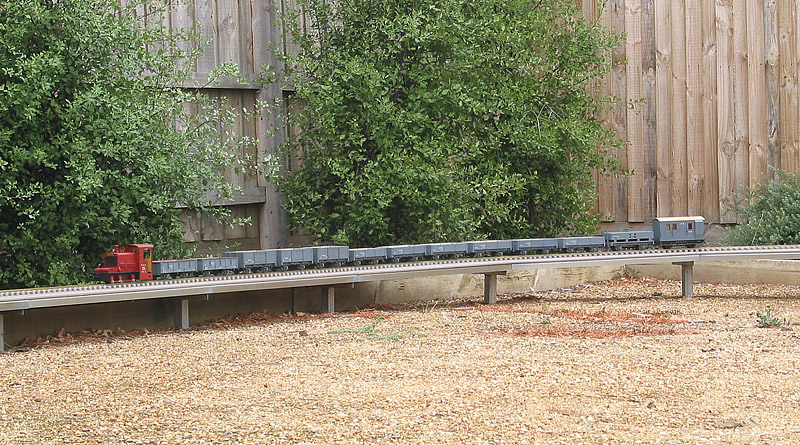
Monday was overcast, but dry, so the new point levers were installed and testing of rollingstock commenced. The First photo shows the old Motor Mule running a train with all the TVT 4-wheel open wagons on test.
- Fourth Run 2.jpg (261.28 KiB) Viewed 5962 times
This loco had major problems running through the turnouts when they were first installed, as the driving wheels have narrow flanges and tyres and the width available between the frames means the back to back is a little narrow for 45mm gauge. It looked like it was going to need a chassis rebuild and new driving wheels, which would be a pain. Luckily the modified point levers gave it enough clearance at the point blades and it now runs reliably.
I now use it for all test running. As others have found, a battery powered loco is perfect for this sort of thing, as it can run at a moments notice, can be set running at a nice even speed and I can then concentrate on what the rollingstock is doing as it runs around. Steam loco running is on hold until the track and rollingstock is running reliably.
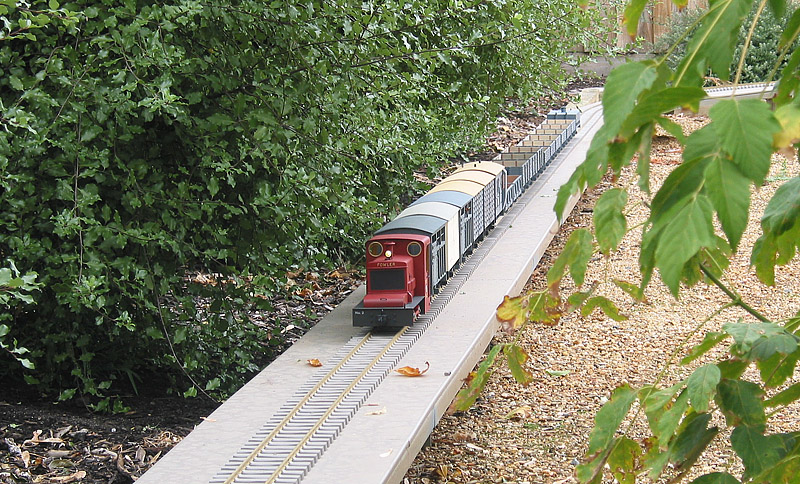
The next photo shows the Mule trundling along the back straight with all the 4-wheel wagons the line possesses. This train is 18 vehicles for 36 axles and I was surprised the Mule could handle it, until I did some test measurements.
- Fourth Run 4.jpg (268.15 KiB) Viewed 5962 times
The train of 4-wheelers has a rolling resistance of 350g on the curves, 250g on the straights. The Motor Mule has a maximum drawbar pull of 475g on dry rail, so surprisingly (to me at least) this train is well within it's capabilities on a flat line like mine. It should also be enough for rescuing the smaller steam locos, but I think I'll need to build something bigger for bringing the Garratt and a train back to the steaming bay.
Out of interest, I did the power calculations and it takes only 0.8 watts to keep this train moving at a scale speed of approx. 15 mph. If memory serves, at that speed the motor draws about 5 watts, so the drive system of a Como motor/gearbox and mitre gear final drive isn't particularly efficient with only 15% of the input power getting to the wheels. Might account for why the motor gets warm even on a cold day.........
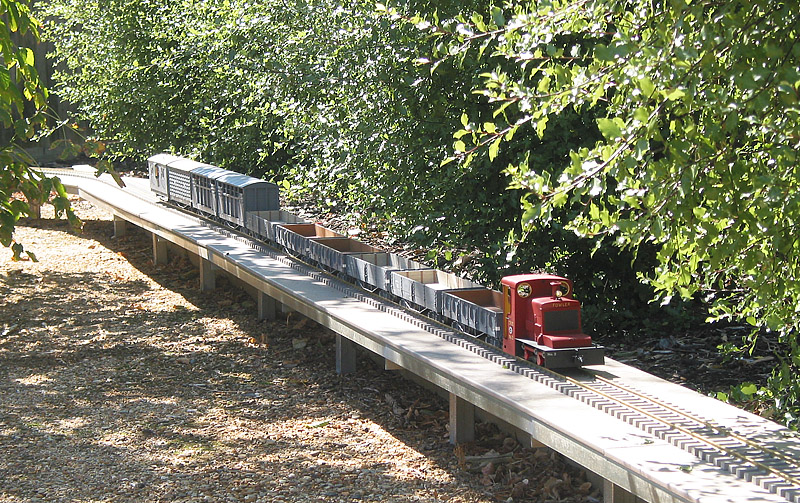
Tuesday warmed up and the sun came out in the afternoon, so it was the turn of the bogie goods stock to be tested. The photo shows the Mule hauling all 10 bogie wagons for 40 axles along the back straight under the Pittosporums.
- Fifth Run 1.jpg (328.59 KiB) Viewed 5962 times
Interestingly, to me anyway, the longer and heavier bogie train has a lower rolling resistance than the train of 4-wheelers, requiring inly 250g on curves and 150g on straights to keep it moving at a scale speed of approx. 15 mph.
That now leaves the passenger stock, the timber bogies and the v-tippers to test run. If the weather co-operates I can get it done before the school holidays start and I get visitors.....
Regards,
Graeme