Australian Log Bogies
Posted: Thu Jan 23, 2014 8:50 am
The workshop has been too hot for loco work (only 31degC today, but it got to 37degC last week), so I've been inside the house finishing off various rolling stock projects, like this one.
These have been a while in gestation, as they were intended as a load for the Hunslet, but I got side-tracked into other projects.
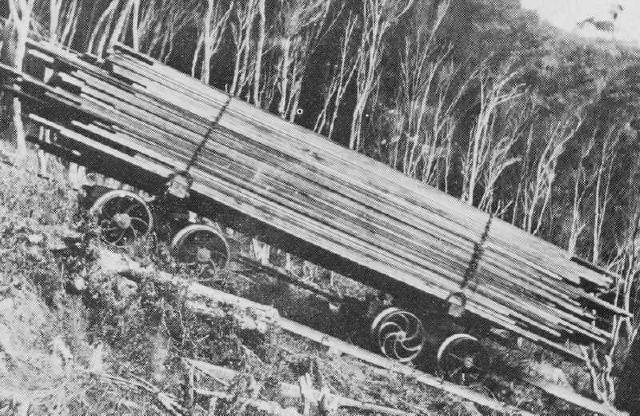
These are based on a common design used on many of the Victorian timber trams, both horse drawn and locomotive worked. Known as the bell brake type, they were used for bringing logs into the bush mills and for transporting sawn timber on the outlet line to the nearest siding on a VR branch line. The wheels and axles were bought in from a foundry in Melbourne or one of the provincial cities, but the rest of the iron work was knocked up by the mill blacksmith and the timber was sawn by the mill as well.
They were referred to in the Aust. timber industry as 'pairs' as that's how they usually ran. The mills also used them to build flat trucks, crude people carriers, gravel trucks, etc. as needed. Timber tramways weren't supposed to carry passengers, but frequently did, especially on the outlet line, as this was the only access for isolated mill communities out in the bush.
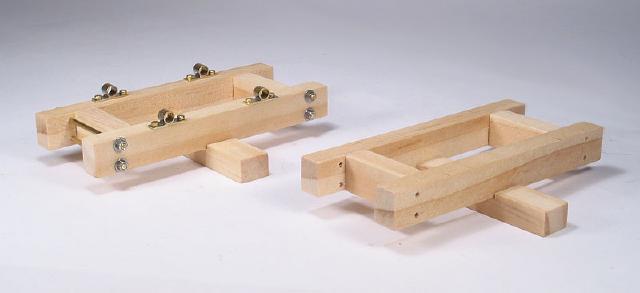
These models are very simple to build and the first photo shows a couple with one just the woodwork glued together and the other fitted with bolts and bearings. The pillow block bearings are fabricated from pieces of K&S brass tube and flat, soft soldered together. I find it easier to fabricate these as a 'stick' about 3" long, then cut pieces off to make the individual bearings.
The next photo. shows two closer to completion with the curly spoke wheels (Andel), brake blocks and swivelling bolsters fitted.

This photo. shows one finished in the usual timber tram finish of weathered wood and rust. Victorian timber companies were usually small and ran on the smell of an oily rag, so paint was an unnecessary luxury. The wood parts have been stained a warm grey and the wheels and iron work painted in my normal rust colour mixed from Humbrol matt enamels. The wheel treads were painted with Humbrol Metal Cote to simulate steel. I suspect this will wear quickly, but it looks better than shiny black treads.

The loads were cut from scrap timber left over from furniture projects. This took longer than building the bogies and even using a saw blade with a 1mm kerf, it generated more sawdust than load.......
The next photo shows the Hunslet pushing a pair loaded with 6' packing case staves through the primeval forest in the backyard. Loads were often pushed on timber trams, rather than pulled, especially on lines with heavy grades.
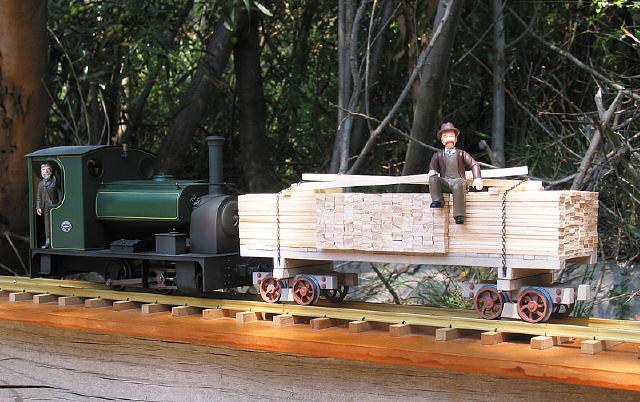
The last photo. shows two pairs loaded with scantlings. The leading one has had the brakes rigged up so the guard/brakeman can provide extra braking power when needed. The bell brake design was controlled by one man riding on the load using ropes, it could also be set up to operate on more than one pair, but the less common board brake design was controlled on each bogie from the track side. The sticks poking up at an angle are twitch sticks, used to tension the chain holding the load in place.

Regards,
Graeme
These have been a while in gestation, as they were intended as a load for the Hunslet, but I got side-tracked into other projects.
These are based on a common design used on many of the Victorian timber trams, both horse drawn and locomotive worked. Known as the bell brake type, they were used for bringing logs into the bush mills and for transporting sawn timber on the outlet line to the nearest siding on a VR branch line. The wheels and axles were bought in from a foundry in Melbourne or one of the provincial cities, but the rest of the iron work was knocked up by the mill blacksmith and the timber was sawn by the mill as well.
They were referred to in the Aust. timber industry as 'pairs' as that's how they usually ran. The mills also used them to build flat trucks, crude people carriers, gravel trucks, etc. as needed. Timber tramways weren't supposed to carry passengers, but frequently did, especially on the outlet line, as this was the only access for isolated mill communities out in the bush.
These models are very simple to build and the first photo shows a couple with one just the woodwork glued together and the other fitted with bolts and bearings. The pillow block bearings are fabricated from pieces of K&S brass tube and flat, soft soldered together. I find it easier to fabricate these as a 'stick' about 3" long, then cut pieces off to make the individual bearings.
The next photo. shows two closer to completion with the curly spoke wheels (Andel), brake blocks and swivelling bolsters fitted.
This photo. shows one finished in the usual timber tram finish of weathered wood and rust. Victorian timber companies were usually small and ran on the smell of an oily rag, so paint was an unnecessary luxury. The wood parts have been stained a warm grey and the wheels and iron work painted in my normal rust colour mixed from Humbrol matt enamels. The wheel treads were painted with Humbrol Metal Cote to simulate steel. I suspect this will wear quickly, but it looks better than shiny black treads.
The loads were cut from scrap timber left over from furniture projects. This took longer than building the bogies and even using a saw blade with a 1mm kerf, it generated more sawdust than load.......
The next photo shows the Hunslet pushing a pair loaded with 6' packing case staves through the primeval forest in the backyard. Loads were often pushed on timber trams, rather than pulled, especially on lines with heavy grades.
The last photo. shows two pairs loaded with scantlings. The leading one has had the brakes rigged up so the guard/brakeman can provide extra braking power when needed. The bell brake design was controlled by one man riding on the load using ropes, it could also be set up to operate on more than one pair, but the less common board brake design was controlled on each bogie from the track side. The sticks poking up at an angle are twitch sticks, used to tension the chain holding the load in place.
Regards,
Graeme