Australian Log Bogies

Discussion of Rolling Stock related topics should go here
Post Reply
User avatar
GTB
Driver
Driver
Posts: 1694
Joined: Sat Mar 05, 2011 2:46 pm
Location: Australia

Australian Log Bogies

Post by GTB » Thu Jan 23, 2014 8:50 am

The workshop has been too hot for loco work (only 31degC today, but it got to 37degC last week), so I've been inside the house finishing off various rolling stock projects, like this one.

These have been a while in gestation, as they were intended as a load for the Hunslet, but I got side-tracked into other projects.

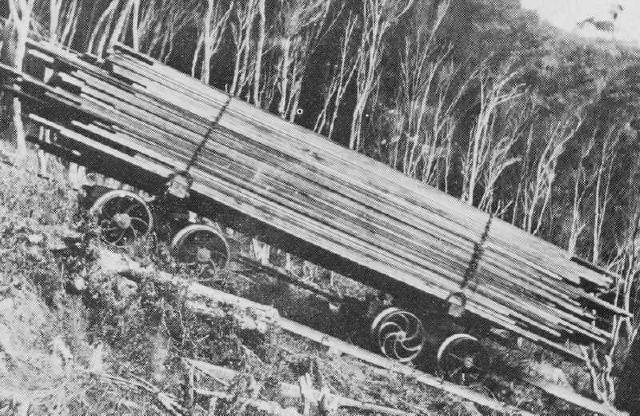
These are based on a common design used on many of the Victorian timber trams, both horse drawn and locomotive worked. Known as the bell brake type, they were used for bringing logs into the bush mills and for transporting sawn timber on the outlet line to the nearest siding on a VR branch line. The wheels and axles were bought in from a foundry in Melbourne or one of the provincial cities, but the rest of the iron work was knocked up by the mill blacksmith and the timber was sawn by the mill as well.

They were referred to in the Aust. timber industry as 'pairs' as that's how they usually ran. The mills also used them to build flat trucks, crude people carriers, gravel trucks, etc. as needed. Timber tramways weren't supposed to carry passengers, but frequently did, especially on the outlet line, as this was the only access for isolated mill communities out in the bush.

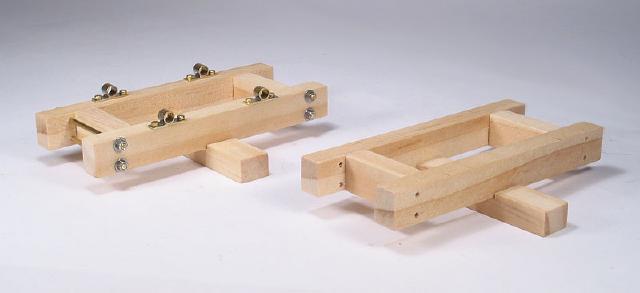
These models are very simple to build and the first photo shows a couple with one just the woodwork glued together and the other fitted with bolts and bearings. The pillow block bearings are fabricated from pieces of K&S brass tube and flat, soft soldered together. I find it easier to fabricate these as a 'stick' about 3" long, then cut pieces off to make the individual bearings.
Image

The next photo. shows two closer to completion with the curly spoke wheels (Andel), brake blocks and swivelling bolsters fitted.
Image

This photo. shows one finished in the usual timber tram finish of weathered wood and rust. Victorian timber companies were usually small and ran on the smell of an oily rag, so paint was an unnecessary luxury. The wood parts have been stained a warm grey and the wheels and iron work painted in my normal rust colour mixed from Humbrol matt enamels. The wheel treads were painted with Humbrol Metal Cote to simulate steel. I suspect this will wear quickly, but it looks better than shiny black treads.
Image

The loads were cut from scrap timber left over from furniture projects. This took longer than building the bogies and even using a saw blade with a 1mm kerf, it generated more sawdust than load.......

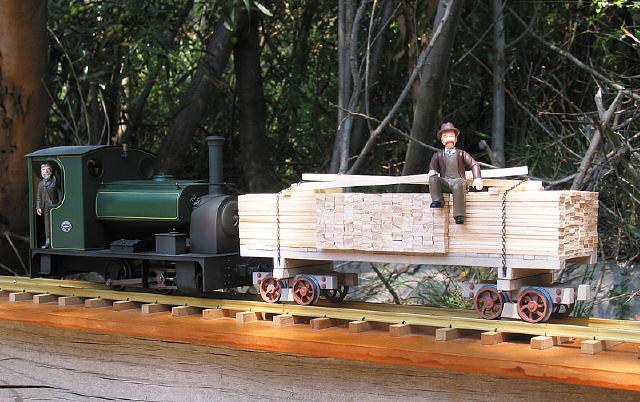
The next photo shows the Hunslet pushing a pair loaded with 6' packing case staves through the primeval forest in the backyard. Loads were often pushed on timber trams, rather than pulled, especially on lines with heavy grades.
Image

The last photo. shows two pairs loaded with scantlings. The leading one has had the brakes rigged up so the guard/brakeman can provide extra braking power when needed. The bell brake design was controlled by one man riding on the load using ropes, it could also be set up to operate on more than one pair, but the less common board brake design was controlled on each bogie from the track side. The sticks poking up at an angle are twitch sticks, used to tension the chain holding the load in place.
Image

Regards,
Graeme

tuppenced

Post by tuppenced » Thu Jan 23, 2014 10:16 am

Wonderful, Graeme!

Here's a busy 3' gauge pair from Warburton, Victoria:

Image

Are you going for rope haulage as well (Piha Incline) ?

Image

David

Droopy

Post by Droopy » Thu Jan 23, 2014 1:32 pm

Well done. I really like it. :D :D :D

User avatar
Soar Valley Light
Driver
Driver
Posts: 1490
Joined: Sun Dec 08, 2013 5:18 pm
Location: North West Leicestershire

Post by Soar Valley Light » Thu Jan 23, 2014 8:47 pm

They are fantastic. I fancy having a go at something similar but freelance when the time comes.

I would have been glad to relieve you of a couple of degrees of heat today whilst I was out in the rain and sleet and freezing cold wind!
"Smith! Why do you only come to work four days a week?
"'cause I can't manage on three gaffer!"

LnBmad

Post by LnBmad » Thu Jan 23, 2014 9:00 pm

Stunning work as ever Graeme!

LnBmad

Post by LnBmad » Thu Jan 23, 2014 9:04 pm

Stunning work as ever Graeme!

Enginehouse

Post by Enginehouse » Sun Jan 26, 2014 1:27 pm

Interesting project. I am feeling a that a project to build a couple of sets of these little trucks is coming on.

So far a background search has not provided much actual detailed build info for scaling. In particular how the bell brake gear linkage actually worked and if there were any draw chains at all fittet to the trucks. From the pics it seems that the motive power unit just buffered onto the cross bars at the end of the wagon truck which were pushed along rather than hauled. This seems not to be very sensible on a downhill run where the bell brakes would have been the only method of slowing/stopping.

A very different little rake to run and whatbseems a pretty straight forward and fun project to scratch build.

User avatar
GTB
Driver
Driver
Posts: 1694
Joined: Sat Mar 05, 2011 2:46 pm
Location: Australia

Post by GTB » Mon Jan 27, 2014 11:54 am

Enginehouse:96070 wrote: So far a background search has not provided much actual detailed build info for scaling. In particular how the bell brake gear linkage actually worked and if there were any draw chains at all fitted to the trucks. From the pics it seems that the motive power unit just buffered onto the cross bars at the end of the wagon truck which were pushed along rather than hauled. This seems not to be very sensible on a downhill run where the bell brakes would have been the only method of slowing/stopping.
There's not a lot on the net. The LRRSA has published quite a few books on the Victorian timber lines over the years and a couple are still in print. There have also been a lot of articles in the LRRSA magazine 'Light Railways' over the last 40 odd years. My interest in timber trams goes back a long way....

Don't think I've ever seen drawings for this type of log bogie, every mill built them a little different anyway. Typical bogie dimensions for a 3' gauge line were 18" wheels (usually curly spoked), with a 2'3" wheelbase and 6' overall length.

Lines that operated with steam locos and/or rail tractors used wooden drawbars with simple link and pin couplings on each end between pairs and to connect the loco to the train. The ends of the sideframes weren't used as buffers, as the load always extended past them. Sometimes they'd have a chain between the bogies within the pair, more rarely a drawbar, but often just relied on the weight of the load and the tension in the chains to keep the bogies and load together.

The bell brake linkage was very simple. There was a cross shaft with squared ends under the fixed bolster, so the handle could be fitted on either side. There was a short crank pointing down on the cross shaft over each brake block, with a connecting link to the block. With the handle vertical, the brake block dropped away from the wheel treads. The brake block would be lifted into contact with the wheels when the brake lever was moved in either direction off the vertical. The control rope was tied to one handle, fed through a block on the other handle and then run back to where the brakeman was sitting. When the rope was pulled, the handles would move towards each other and apply the brakes. Ropes could be run along the train, so one man could apply the brakes on more than one pair. This was more common on logs, than on sawn timber trains.

On a horse worked line, a team of horses would pull one loaded pair at a time. They would be unharnessed at the top of a steep grade and the load would roll down with the driver controlling the speed, followed by the horses. Experienced horses would stop at the top of the grade and refuse to proceed until unharnessed........

Loco worked lines would usually push the load from the rear in hilly country, but were coupled to the train with a drawbar, not loose. Some lines followed horse line practice and uncoupled the loco at the top of a grade. That way, if the load got away, the brakemen would bail out and the loco, wouldn't have to be retrieved from a creek. If the line was fairly flat, they would be at the front. Most of the locos used were small, so loads were light. Photos. of Coffee Pot on the Powelltown line show it pulling only three or four pairs at the bush end of the line.

Really steep grades were rope worked inclines, sometimes balanced inclines, but not always. Horse worked lines could be as steep as 1:12, but less for locos., say 1:20. The steepest grades were at the bush end of the lines where the trees were cut and this was where bogies would be used for carrying logs. Cut logs would be dragged out of the bush with a steam winch then loaded on bogies for the trip to the mill.

The mill would be in the bush, but lower down the valley. Cut timber would be transported from there over the flatter part of the line to the transhipment siding where it would be loaded into VR open trucks. Often by hand, as not all VR stations had a crane and even if they did, most were hand operated.

Forestry is still the most dangerous industry in Australia, as it was in the past. Runaways on the tramways were common and the remains of log bogies can still be found under the ferns in deep gullies where there was once a bridge, or a sharp curve at the bottom of a steep grade.

Graeme

Enginehouse

Post by Enginehouse » Mon Jan 27, 2014 8:31 pm

Thanks very much for all of the additional info. There are a couple of interesting offerings on Youtube and some odd Oz logging historical sites, but obviously hard copy is definitely the way to go.

It's nice to see your sawn timber loads rather than just the logs. Fun job out in the workshop on a wet day.

jim@NAL
Driver
Driver
Posts: 1142
Joined: Sun Sep 23, 2012 11:01 am
Location: haverhill suffok

Post by jim@NAL » Mon Jan 27, 2014 9:28 pm

that's very impressive I like it a lot

Post Reply

Who is online

Users browsing this forum: No registered users and 0 guests