Yes - very true.
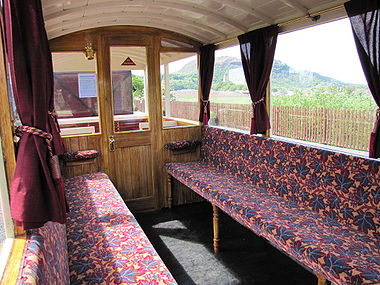
In the first preservation incarnation the interior walls were painted cream down to the floor, but are now stained wood.
Further details are
Festipedia LINK.
My notes suggest that after dual braking in 1923 it was exterior uniform green colour, interior cream ceiling only with seats at least painted in a medium brown [1] - the first class section was derated after spending 1915 - 22 out in the open at Dinas. There is a hint of varnished mahogany beading around both the fixed lights and open section window opening (as they were going to be glazed at one time).
1891 - 1915 has the cream upper works outside, with NWNG maroon beneath; top horizontal of open section cream and the rest of the woodwork of the walls in a pale varnish with mahogany cornerposts and framing filled in with pitch pine planks. Grey floor. The current refit is very, very close indeed to how the carriage was at delivery.
The only really unfathomable area (apart from the colours of the upholstery in 1891 - 1915) is the interior colour after dual braking (in the FR era) - the trend for most of the carriages seems to have been to paint the ceilings cream, paint the (solid) seats a medium brown and revarnish the woodwork, by now much darker than the original pitch pine as supplied. I suspect that the slatted seats were merely revarnished, although they do appear slightly lighter than the walls of the open compartment, that may be a trick of the light (as likewise with the mahogany finishing on the openings post 1923); Kentish Green can look most peculiar when rendered in black and white.
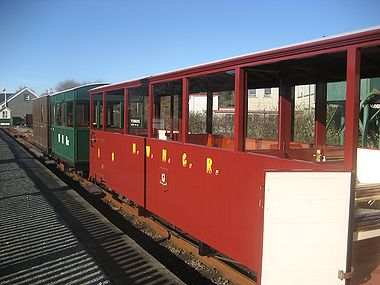
The only other thing of note was that the exterior was repainted in the early May of 1934 prior to the FR lease period, changing from Kentish Green to a rather nondescript red (this repainting is borne out by details of the carriages standing at Dinas during the second closure period). Additionally, during its first incarnation, the seats did not have slatted bases, they were shaped and perforated like tramway cars.
[1] not conclusive, it could be varnished mahogany. Some NWNG carriages during the HFS period had very, very dark interiors and seems most likely to be as a result of revarnishing of the wood, though some seats were painted. It depended on the manufacturer of the coach.
I suppose in essence if you want......the best answer is cream ceiling, brown wood interior with the seats being darker than the walls and a light grey floor.