Philosophy and theory
Hopefully, this is not too dull a post to read, but I think it is helpful to explain the ‘why?’ of my figure painting approach, before diving into the ‘how?’.
I do think figures are important to include in a model railway. People operate and maintain the trains and the railway infrastructure, load and unload goods, and get carried around as passengers. To me, a model railway looks somewhat lacking with driverless trains pulling around empty carriages. It is therefore important to me to include figures that complement the rest of the railway scene.
So what am I trying to achieve in painting a realistic looking figure?
Colour
Firstly and most obviously, painting to achieve a realistic look means adding colour to the figure to represent the colour of skin, hair, clothing, etc. These colours should reflect the almost infinite variation seen in real life to skin tone, hair colour, fabrics, etc.
The dyes available historically in the clothing industry, at least up to the middle of the 20th century, mean that clothing colours were typically more restricted in the past than is the case more recently, particularly for working clothing. More vibrantly coloured fabrics were more expensive and therefore only likely to be seen on people who could afford them or worn for special occasions. Similarly, people who worked outside would quickly develop tanned and weather-beaten features as opposed to the fair skin of those that spent their time indoors. The colours we choose can therefore help tell a story about the person our model figure is representing.
Highlights and shadows
This is probably the single most important consideration in making model figures look like real people. Whilst we can model figures to be highly accurate, to scale and include intricate details, just painting areas of the figure in single uniform block colours results in a very flat and uninteresting-looking model, lacking realism, even though we might be trying to represent, for instance, an item of clothing that is a single colour. The reason for this is we can’t scale light rays.
In full size, light rays from the sun, artificial lights and reflected from the surroundings will fall on various curved surfaces, edges, folds, creases, wrinkles to produce areas of stark highlight and shadow, appearing as light and dark variations of the base colour. On a scaled-down model, these features are smaller so the shadows produced are less deep and highlights are less pronounced.
One of the good things about figure painting is that you’ll always have a full-size prototype available to refer to, i.e. yourself! Using me as a reference (my profile picture), you can see how the colours of, for example, my jacket range from dark to light tones. This photo was taken inside (sat in a carriage on the charming and idyllic L&BR). I am lit by reflected light coming through the windows, the variation in tones would be more pronounced if I was in direct sunlight or lit from another direct source such as a light bulb.
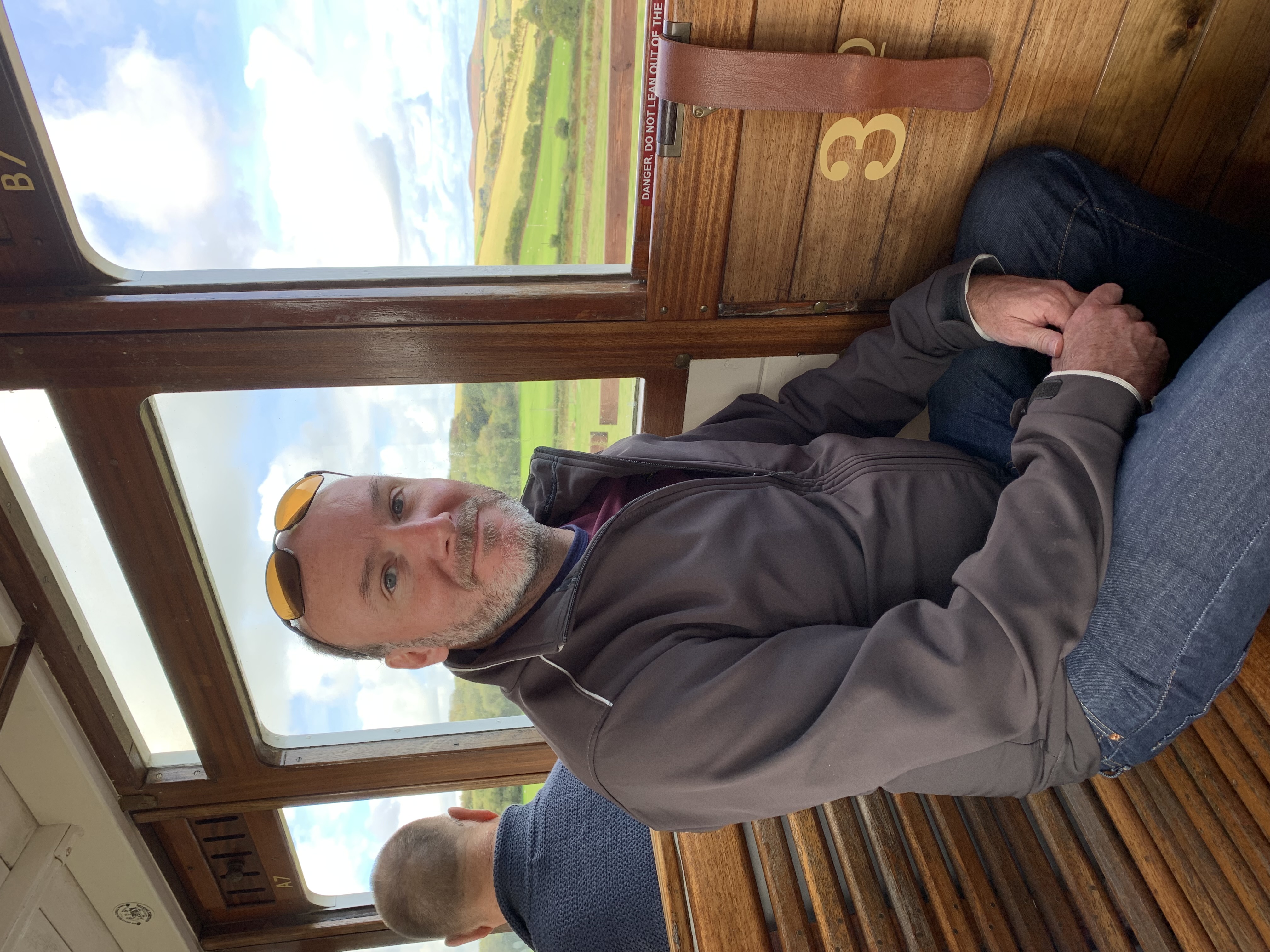
- IMG_2535.jpeg (2.54 MiB) Viewed 2213770 times
Using some picture editing software, I have isolated areas of my jacket to illustrate the tonal variation portrayed in the photo from highlight, through the mid-tone to the shadow. Notice the range in tone and how the highlight is light but nowhere near white and how the shadow is dark but not black. Also notice how the variation in tone across my jacket is graduated with no abrupt changes in tone. It is these effects that need to be painted on the model figure to supplement the natural highlights and shadows produced by the ‘over-scale’ light rays our model is exposed to.
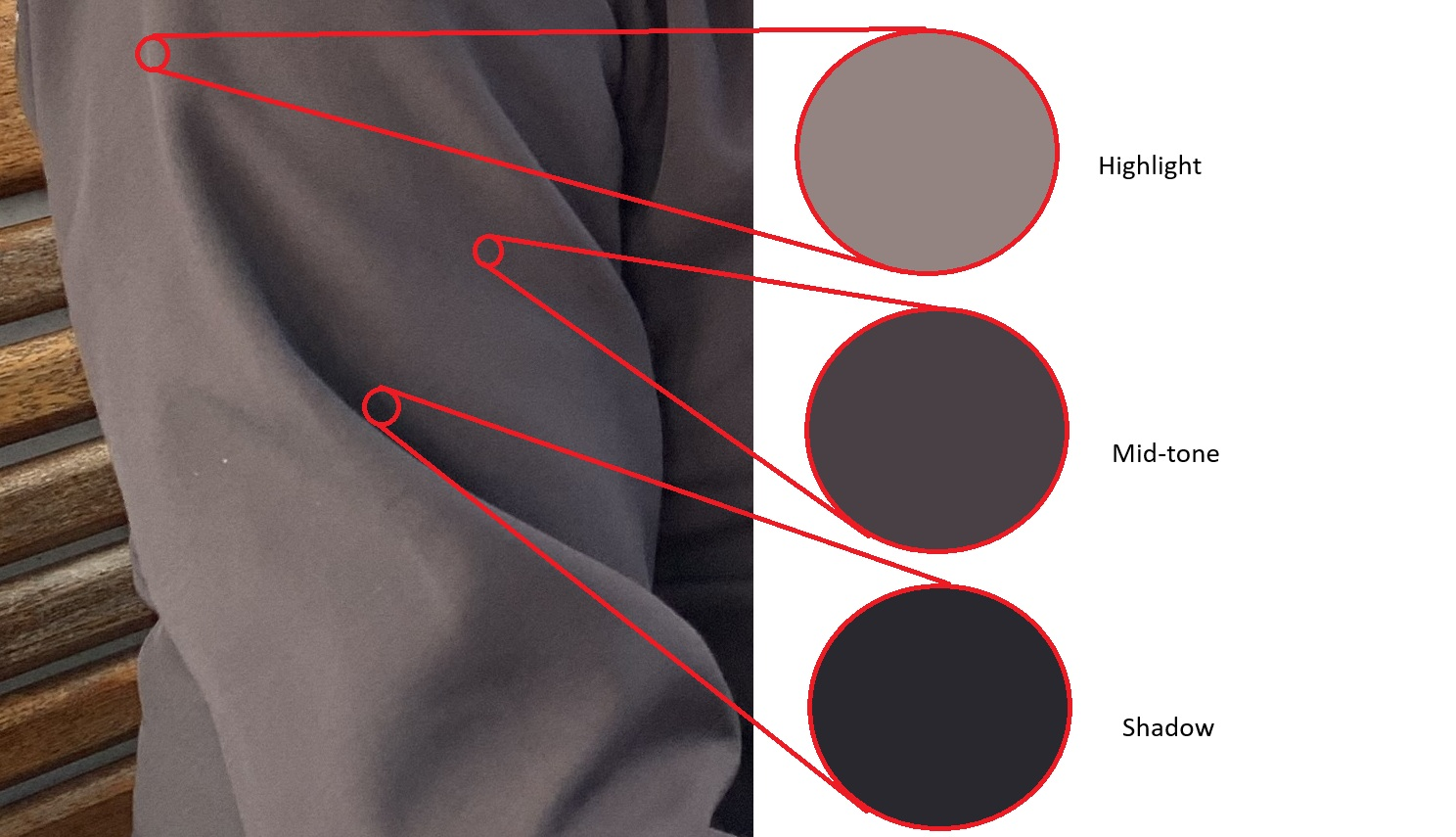
- Highligh-shadow.png (1.26 MiB) Viewed 2213770 times
Incidentally, ‘over scale’ light rays and resulting impact on highlight and shadow are equally relevant to other subjects of our modelling (locos, rolling stock, buildings, etc.), but these effects are generally only considered under the somewhat misleading term of ‘weathering’ where techniques such as washes and dry brushing are often employed to add depth through supplementing the shadows and highlights.
Texture
Our model figures will generally be moulded or 3D printed in plastic, resin, white metal, etc. There is a limit to the level of detail that can be represented through these materials when trying to portray delicate and organic features such as hair, fabrics, leather, skin, etc., that may be modelled as solid lumps on our figures. Painting effects can help trick the eye into reading surfaces of the model as being made of particular materials.
Details
Details such as eyes and mouths can add character to a model figure, but are easily overdone leading to an unrealistic or cartoonish look. Garden railway scales are generally large enough that they allow details to be picked out, but I prefer to keep things subtle.
Wear and dirt
Again, subtle is the key word here, but where appropriate I like my figures to look like they have not just put on a freshly laundered outfit. Rather they should look as though they have spent time in their relevant environment, showing signs of dirt, grime, dust, etc., with clothing worn and faded where subject to hard work and exposure.


