Page 1 of 1
Drawing from the buffer or the bogie??
Posted: Fri Dec 05, 2014 10:59 am
by robc_wa
Inspired by the article in the recent Garden Rail, I ordered a quartet of Newqida coaches from Hammonds in the US in order to convert them to 32mm gauge
They arrived today, jolly prompt service in fact so I had a look at them in company with the article.
Now, the article suggests moving the centre buffer to the bogies to replace the G scale type coupler there. However the only bogie vehicle the Frederickstown Tramway currently has is a scratch built open wagon which is drawn ( in what I believe is prototypical fashion) from the buffer beam rather than the bogies. We have no problem with the current 4ft min radius, but I am used to drawing from the bogies in my N gauge days when hauling Mk1s round 9 in curves!
What is usual in SM32? and does anybody have a magic formula relating vehicle length, bogie separation and possible radius to not require drawing by the bogie? I am aware that coupler height is another problem for such a conversion, but "one bridge at a time"
Thanks in advance
Rob
Posted: Fri Dec 05, 2014 12:48 pm
by ge_rik
Interesting question. I model SM45 rather than SM32 but when I constructed a set of coaches from kits, rather than placing the coupling on the drawbar as per prototype I, like you but with a 4mm modelling background, decided to fix the couplings to the bogies as I have some very tight curves on my railway and figured I might run into trouble.
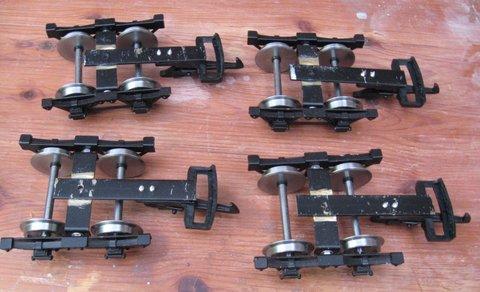
However, in the real world, narrow gauge coaches seem to operate very successfully negotiating tight curves while being drawn from the drawbar and, if you think about it, the trailing bogie on each coach has to find its own way around the curves.
I'll be interested in others' views and experiences on this topic as I'm currently bashing some Bachmann coaches and they have couplings attached to the bogies.
Rik
Posted: Fri Dec 05, 2014 4:14 pm
by Peter Butler
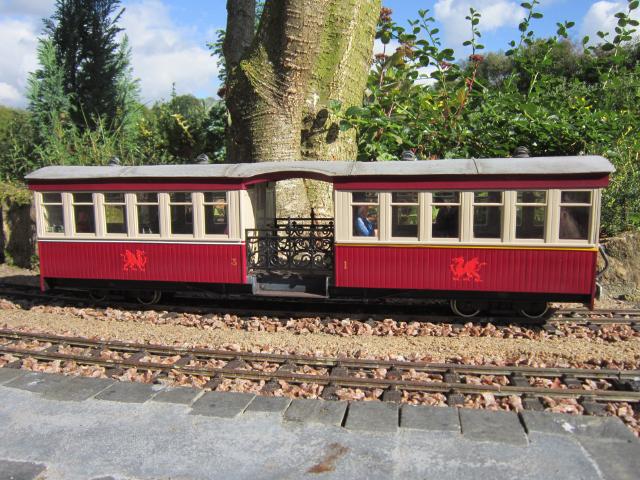
On my own three Bachmann coach conversions to 32mm gauge I removed the bogie couplings and use chain link instead. Because of the balcony overhang I have to use 4 rather than 3 links of chain and am restricted to forward motion only. Despite this I much prefer to see chain rather than bogie couplings.
Posted: Fri Dec 05, 2014 4:29 pm
by TonyW
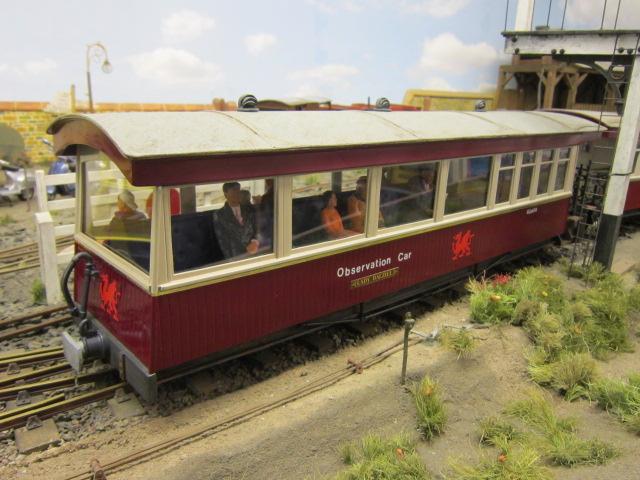
Another method to achieve much the same result is to follow full-size practice and pivot the coupling independently of the bogies. The picture of Ffestiniog carriage 19 shows the slot in the buffer beam that allows the coupling arm to slide from side to side, but the arm has its own pivot between the buffer beam and the bogie pivot. Most Ffestiniog rolling stock has this arrangement, including the locos.
https://www.flickr.com/photos/rpmarks/4346697728
Posted: Fri Dec 05, 2014 7:46 pm
by steamie1
Hornby and Bachmann do this on their coaches. They have started to have a cam arrangement underneath to guide the first part of the movement of the draw bar. Its all good on flat curves when the track has bumps and is not level, problems. Look at Accucraft. the coupling pivots and is tensioned with a spring. If one keeps the overhang low I think this is the best method. Coupling bogies causes problems on uneven surfaces or hill crests.
Posted: Mon Dec 08, 2014 6:29 am
by IrishPeter
I use headstock mounted Accucraft 'Norwegian' chopper couplings on my rolling stock. They'll pretty much put up with anything down to 3' radius on a simple curve, but one has to be cautious with 'S' bends when mounting couplings on the buffer beam. My usual solution - given that I use up to scale 42' (568mm) stock in 1:22.5 scale - is to introduce a short section of straight track into an 'S' bend to alleviate the geometry problem. It also helps to have the bogies as close to the outer end as practical as this reduces the amount throw at the outer ends of the carriages. So far as Colonial Railways are concerned end balconies big enough to hold a dinner & dance upon are out!
Cheers,
Peter in AZ
(Chief Dogsbody - Colonial Railways)