Page 1 of 2
steam up pit
Posted: Mon Aug 11, 2014 11:08 pm
by Gremlin
My line is ground level and making some alterations. I now have space for a steam up pit. My idea is to be able to sit at ground level with my feet in a pit as scrabbling around on my knees isn't much fun at times and I'm looking to the future to make things easier.
I'm on clay soil but I plan to dig down so that under the floor there is a further 12 inches that will be filled with rubble and shingle to act as a soak away.
Has anyone any experience of this sort of thing? I am aware that in wet winter there is still the chance of creating a pond, could always wear wellies

Posted: Mon Aug 11, 2014 11:16 pm
by Peter Butler
Sounds like a most sensible idea to me!
I too have clay soil (more clay than soil!) but underneath is shale and that should soak away the wet if you dig far enough. If you dig so far you can stand up that's a bonus!
Posted: Tue Aug 12, 2014 6:44 am
by kandnwlr
One of the variants I´ve seen is a bit about 18-24 inches deep with a place to sit with legs stretching out under the rails. Helps if the place to sit has some form of waterproofing :D The interesting thing was that the pit was built at an angle with the deepest part where the feet would come to rest and less digging done on the sitting side. Very economical approach :o
Posted: Tue Aug 12, 2014 7:35 am
by philipy
Do keep us updated on this one, please. I've wondered about doing something similar but I am also on clay, and underneath that is clay, followed by clay and yet more clay. Even though the garden is on a slight slope, when we get a good downpour the water sits on top of the grass ( before it runs to the bottom and forms a lake!).
Steam up pit
Posted: Tue Aug 12, 2014 9:32 am
by MVL Bridges
Yes, it worked for me. I made a pit or 'Operating Area' as I called it back in the early1980s for my ground level SM32 line. I lined the pit with a wall of breeze blocks mortared Iin place and gave it a floor of several jnches of gravel. I never had a problem with flooding. I incorporated steps down into it. It was about 8 feet x 3 feet although the hole I dug had to be correspondingly bigger to allow for the block lining. It was a terminus on my line with four tracks and an engine shed. The four tracks combined into two which led off to a triangular junction onto the main line around the garden.
The pit was a great place to prepare engines and rolling stock. It was also ideal for sitting and talking trains. As radio control was more scarce in those days it did mean occasionally leaping out of the pit to catch a train. Perhaps a point to note is to put the steps at thr end where the trains leave!
Sadly both the line and the garden have now changed dramatically. The Operatinng Area now lies under a large shrubbery however I am convinced that if it ever became necessary it could be resurrected and brought back into use.
OK you ask, where are the photos? I believe I may have two which show the pit. Most photos ignored the pit and focussed on the railway. I will try to hunt them out. Remember this was before digital photography! And what sbout the railway? The New Herrington Light Railway has been rebuilt in a larger format and has uts next Open Day next Saturday.
I hope this has been helpful.
Michael
Posted: Tue Aug 12, 2014 10:02 am
by tom_tom_go
Hi David,
I had a word with our friendly builder who has done work before around your way and he says that if you dig down you will eventually find chalk layer which is perfect for drainage.
He suggests you put in a soak away tray which you can get from Jewsons, etc and then on top of that put down a membrane (I can't remember what he recommended sorry) so it allows water to go through but not mud and rubbish. You then want to put 20mm gravel down.
The sides can then be clad with decking timber again using the membrane behind it.
Steam up pit
Posted: Tue Aug 12, 2014 10:07 am
by MVL Bridges
I should have added that one of the problems with a gravel floor where you work on engines and rolling stock arises when you drop that tiny grub screw, washer, etc. They just get swallowed up in the gravel!
Michael
Posted: Tue Aug 12, 2014 12:32 pm
by Gremlin
thanks for a nice lot of replies and good to know someone has done it before, I was sure someone would have.
This is going to be small, I'm thinking of using 18" paving slabs (because I have some) so I don't have to dig it twice as big to allow for bricks. Probably only have enough room for 2 plus a 9" step as the track will curve straight after that. the ends and floor will be inside the walls so stopping them moving in, then a metal hook to secure the middle. will have a play with things this afternoon.
Posted: Tue Aug 12, 2014 12:38 pm
by Peter Butler
I'm pleased to hear the weather in Kent is fine enough to allow digging in clay soil. Here in wet West Wales the rain has been so heavy that my clay would be like digging Bostik.
Be good to see the results of your labours.
Re: Steam up pit
Posted: Tue Aug 12, 2014 2:36 pm
by williamfj
MVL Bridges:103236 wrote:I should have added that one of the problems with a gravel floor where you work on engines and rolling stock arises when you drop that tiny grub screw, washer, etc. They just get swallowed up in the gravel!
Michael
Done it a couple of times & seen it quite a bit too, I've always thought a sensible solution would be trays, inclined with a fine mesh at the lowest end allowing the water & oil that inevitably accumulates to drain without taking whatever vital part with it into the gravel black hole below.
Posted: Tue Aug 12, 2014 5:34 pm
by Gremlin
well not being one to talk about it and do nothing, here is an afternoons digging. I forgot just how much fun clay is and as you get used to that the joy of flints jars your arm. During the dig the clay changed colour but was still clay, although damp is wasn't rining wet and no water started to collect in the hole.
What I did underestimate was the amount of spoil that was to come out of a relatively small hole. One heavy trip to the dump and the same amount to go again. If it doesn't pan out I could always start making pots, I'm the clay is that clayey

Posted: Tue Aug 12, 2014 10:30 pm
by jim@NAL
nice hole well done
Posted: Tue Aug 12, 2014 11:19 pm
by Peter Butler
Excellent start... the ground there looks to be dry and not like the grey clay we have here which is wet and sticky. It is also extremely slippery.
Posted: Tue Aug 12, 2014 11:25 pm
by METHSSNIFFER
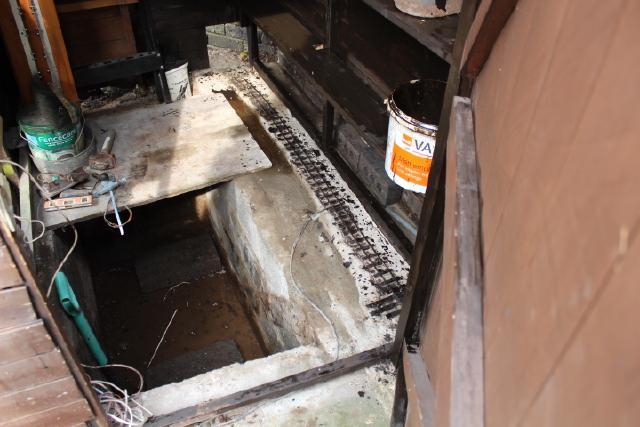
I have a pit in the shed. I hope one day to have a hydraulic platform that I can lower myself into it rather than jumping in and out at the moment. Pit is 3' deep and measures 5' x 3' is fully lined with membrane and breeze blocked.
Posted: Tue Aug 12, 2014 11:54 pm
by Peter Butler
What you need is one of these.....
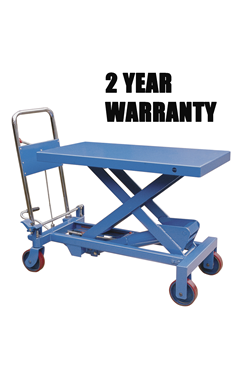
This one would fit into your pit and costs less than £200. (+vat)
Posted: Wed Aug 13, 2014 12:07 am
by METHSSNIFFER
Indeed!
Posted: Wed Aug 13, 2014 8:07 am
by Gremlin
that's a very nice pit you have, if you fit the platform I do hope the theme from Thunderbirds will play as you descend
will do a bit more today, though everything aches

Posted: Wed Aug 13, 2014 5:47 pm
by Gremlin
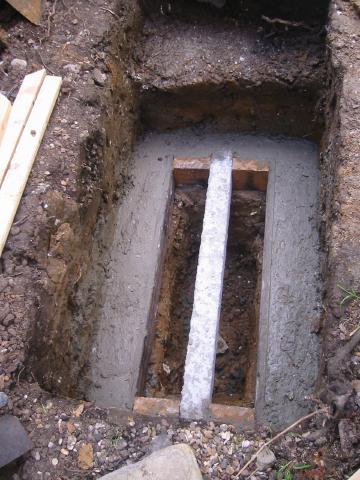
todays progress. I bought a concrete lintel to run down the middle and made the same sort of thing in concrete to form the floor support all the way round. The paving slabs will be mortared in place
The hole underneath will be filled with rubble and shingle, mainly to give support to the walls but allow water to collect and soak away.
Posted: Wed Aug 13, 2014 10:06 pm
by Peter Butler
This is turning into a serious civil engineering project and will last for years. You have thought it through and know what you want to achieve, so ' more power to your elbow!' (as they say).
Posted: Thu Aug 14, 2014 6:15 pm
by Soar Valley Light
That's looking like a real good job Gremlin. The soakaway capacity looks like it ought to cope with any but the most exceptional rain falling into the pit, it's a small enough catchment area after all.
What is the lie of the ground around the pit like though? Does the ground fall towards the pit on any side? If it does then some sort of shallow grading of the surface to act as a cut off might be very prudent.
Andrew