Another question for the resin experts.
I have a 2nd hand Cheddar/GRS Tram which has a resin skirt and a separate resin body & roof. The body has been resting against the ceramic burner at one end and the resin has bowed out due to the heat transfer.
I would like to straighten that bowing out of one end. Reading back through advice on these Forums I could put the body in hot water to reshape it, or place it in a hot oven and do the same.
With both the above methods the whole body is going to be affected and it would be harder to keep the overall rectangular shape.
As the heat of the ceramic burner has caused the problem I wonder if using a hair dryer over the affected portion would be enough to heat up just enough of the resin to be reshaped, whilst not affecting the rest of the body (it could be wrapped in wet paper towels or similar to prevent too much heat transfer).
Would this work?
Chris Cairns.
Reheating Resin
-
Chris Cairns
- Driver

- Posts: 2372
- Joined: Mon Oct 29, 2007 7:25 pm
- Location: Glasgow, Scotland
-
Narrow Minded
I'm pretty sure that the hair drier will give you enough heat to soften the resin, but I'm not sure how the "localisation" idea will work out.
I'd be worried that any force applied to try and re-shape the heated area might cause a fracture on a "cool" adjoining section.
Have you got any scrap resin mouldings you could experiment on?
I think I have a couple of unused bits from buildings - I'll try and find them tomorrow.
I'd be worried that any force applied to try and re-shape the heated area might cause a fracture on a "cool" adjoining section.
Have you got any scrap resin mouldings you could experiment on?
I think I have a couple of unused bits from buildings - I'll try and find them tomorrow.
-
MDLR
-
GTB

- Driver
- Posts: 1716
- Joined: Sat Mar 05, 2011 2:46 pm
- Location: Australia
Re: Reheating Resin
It depends on the resin used for the castings.Chris Cairns:83467 wrote:I have a 2nd hand Cheddar/GRS Tram which has a resin skirt and a separate resin body & roof. The body has been resting against the ceramic burner at one end and the resin has bowed out due to the heat transfer.
Polyester and epoxy casting resins can be heated to soften them for reshaping and they will stay that way when cooled. Polyurethane is different and may not stay permanently flat after heating.
The problem with applying a hair dryer to just the affected spot is that it will probably heat up other areas as well and you may find yourself going in circles.
I'm not familiar with the model, but if you are trying to reshape what is basically a box, the safest way would be to make up a light ply frame that will support the rest of the body and keep it square while it is hot.
A hair dryer should be plenty hot enough, as you only need to get the resin up to around the same temp as boiling water. A hot air gun would be too hot and since resins are good heat conductors, it may well melt the surface detail before the heat penetrates through the casting enough to soften it.
As an example, the castings of the engine cover on my old Merlin Motor Mule had warped over time and needed to be flattened out. I found it was easier to disassemble the glued joints so I had components that could then be heated in the oven on a piece of glass until flat. Took about 1/2 hr in a 100C oven as I recall.
As the americans say, 'your mileage may vary'..........
Graeme
-
Narrow Minded
Sorry for the delayed reply Chris - the only scrap bits I have are too thick (low relief building end walls) to make a reasonable comparison with.
As Graeme said, I'm not familiar with the model, but if you can separate the individual panels to work on I'd recommend doing so.
(Having said that, if straightening fails could you replace the affected panels with plasticard scratchbuilds?)
As Graeme said, I'm not familiar with the model, but if you can separate the individual panels to work on I'd recommend doing so.
(Having said that, if straightening fails could you replace the affected panels with plasticard scratchbuilds?)
-
Chris Cairns
- Driver
- Posts: 2372
- Joined: Mon Oct 29, 2007 7:25 pm
- Location: Glasgow, Scotland
Thanks to Greg, Brian & Graeme for their responses.
I had asked the question ahead of finding my Tram (took 2 days to find which box it was hidden in) and assumed that when GRS & the Garden Rail review said the body was made of resin it was similar to the resin I've experienced with products from AnDel, Modeltown & Swift Sixteen.
However it seems that resin is a very general word for a large range of chemicals used, including the everyday plastic bottles.
So here is the offending 'resin' body.
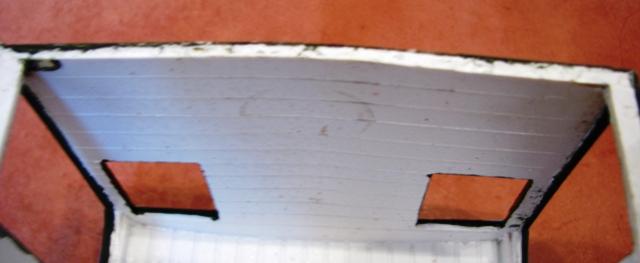
(You can just see the circular imprint made by the end of the gas burner)
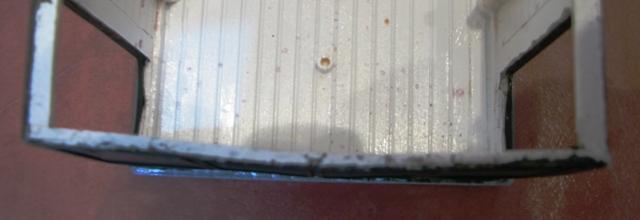
So this 'resin' is plastic based and should reshape with some gentle heat applied. However the body is actually from a GRS G64 kit and the modified Cheddar Iver chassis has been 'shoehorned' inside. I'll need to fit some sort of thin insulation material to the inside to prevent a re-occurrence of this bending (the hole in the roof around the safety valve has been similarly affected).

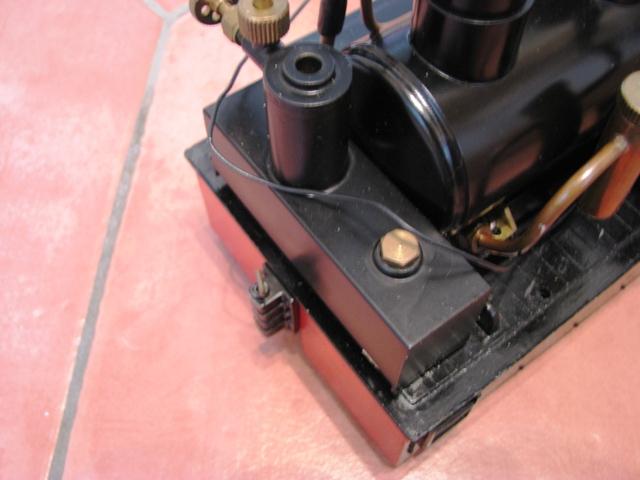
I've not had any success so far locating a copy of the original instructions, but suspect the R/C has been fitted by a previous owner (not factory fitted). So a slow strip down to get it running mechanically, decide whether to keep the R/C on-board or fit it in the accompanying van, then repair, repaint and fit out that body.
Chris Cairns.
I had asked the question ahead of finding my Tram (took 2 days to find which box it was hidden in) and assumed that when GRS & the Garden Rail review said the body was made of resin it was similar to the resin I've experienced with products from AnDel, Modeltown & Swift Sixteen.
However it seems that resin is a very general word for a large range of chemicals used, including the everyday plastic bottles.
So here is the offending 'resin' body.
(You can just see the circular imprint made by the end of the gas burner)
So this 'resin' is plastic based and should reshape with some gentle heat applied. However the body is actually from a GRS G64 kit and the modified Cheddar Iver chassis has been 'shoehorned' inside. I'll need to fit some sort of thin insulation material to the inside to prevent a re-occurrence of this bending (the hole in the roof around the safety valve has been similarly affected).
I've not had any success so far locating a copy of the original instructions, but suspect the R/C has been fitted by a previous owner (not factory fitted). So a slow strip down to get it running mechanically, decide whether to keep the R/C on-board or fit it in the accompanying van, then repair, repaint and fit out that body.
Chris Cairns.
-
GTB
- Driver
- Posts: 1716
- Joined: Sat Mar 05, 2011 2:46 pm
- Location: Australia
To be pedantic, all plastics are resins, but not all resins are plastics. They are all polymers though........Chris Cairns:83522 wrote: So this 'resin' is plastic based and should reshape with some gentle heat applied. However the body is actually from a GRS G64 kit and the modified Cheddar Iver chassis has been 'shoehorned' inside. I'll need to fit some sort of thin insulation material to the inside to prevent a re-occurrence of this bending (the hole in the roof around the safety valve has been similarly affected).
What are commonly called plastics fall into two categories. Thermoplastic polymers can be melted and are used for injection moulding etc. The thermosetting polymers are generally two part resins and are the type referred to as casting resins. They soften with heat, but generally will burn before they melt.
If these models were sold ready to run, I'd contact GRS to see if they have an archive copy of whatever instructions existed and to find out which particular type of casting resin was used for the bodies.
This link has an article on building one of these from an Iver chassis and a GRS tram kit, which might help.
http://g3madesimple.org.uk/LNER_Y6_Tram_Loco.pdf
Personally, I wouldn't use any polymer for a closed body wrapped around a live steamer mechanism. It's the live steam loco equivalent of a chocolate teapot...........
Looking at the photos, you have two problems and while the permanent distortion is a result of the heat, it was not the root cause.
The body is a little too short to fit over the mechanism and has been forced on. This puts a bow in the end and the heat from the burner softens the casting, allowing it to take up a permanent bend to reduce the stress in the casting.
The giveaway is the imprint of the burner on the inside of the body. If you just straighten the body, it will bend again when the body is fitted to the chassis and a layer of insulating material will just force it further out. A very thin insulator will stop the burner melting further into the casting, but will still make the bulge bigger when the body is fitted onto the mech.
The only permanent solution is to cut off the body ends and refit them to the sides with filler pieces to make the body longer, so there is enough clearance over the mech. The floor/skirt casting will also need cutting and shutting to lengthen it and the buffer beams will need spacers behind them, if you don't want the body to overhang the chassis.
Regards,
Graeme
-
Chris Cairns
- Driver
- Posts: 2372
- Joined: Mon Oct 29, 2007 7:25 pm
- Location: Glasgow, Scotland
Hello Graeme,
Many Thanks for your comprehensive reply, and I apologise for the slow reply (been contemplating the rebuild).
The Tram body is indeed a tight fit but I think there are a couple of areas which can be improved on with the chassis to get a few more mm's of space.
More to come on my Cheddar/GRS Steam Tram topic - http://gardenrails.myfreeforum.org/about163.html
Chris Cairns.
Many Thanks for your comprehensive reply, and I apologise for the slow reply (been contemplating the rebuild).
The Tram body is indeed a tight fit but I think there are a couple of areas which can be improved on with the chassis to get a few more mm's of space.
More to come on my Cheddar/GRS Steam Tram topic - http://gardenrails.myfreeforum.org/about163.html
Chris Cairns.
Who is online
Users browsing this forum: No registered users and 64 guests