I am a bit tired of doing four-wheelers and bogie vehicles, and I am thinking that I ought to have a go at a six-wheeler as they were fairly common in Ireland. So has anyone here built a Cleminson Patent type of underframe? I did one in 00n3 ages ago, which was not a stellar success, but worked when it was not falling apart! The worst problem in that small scale was making the links between the three trucks robust enough. BTW, all I had to go on was some notes made when I had a looksie with a torch under N40-wharever in Port Erin Museum, and I ended up simplifying the design somewhat..
Any advice appreciated.
Peter in AZ
Cleminson Patent Underframes
-
MDLR
You might care to look at:
http://www.yattonmodelengineering.co.uk/clemisons.html if you don't mind buying a kit, and he might be willing to supply just underframes, seeing as how the bodies are separate from the underframes.....................
http://www.yattonmodelengineering.co.uk/clemisons.html if you don't mind buying a kit, and he might be willing to supply just underframes, seeing as how the bodies are separate from the underframes.....................
-
IrishPeter
This idea has been laying dormant for about 10 months, but my interest in the Cleminson underframe has revived again due to another out break of Manx Northern fever.
Looking at the various ways of doing it I have come to the conclusion that the piano wire method results in a slight understeer of the outer wheel sets, which, knowing the SCLR's P Way will result in a ground fault. The alternative seems to be to cross the wires to produce a double X so that centre right steers right left and left left (if you see what I mean), or arrange 'stiff' pivots mid way between each axle, as per the original patent.
Having reached that conclusion it is off to the junk box to see what sort of a contrapion I can come up. Millie needs something new to pull, and the MNR six wheelers are about the right size envelope - 30' by 7' - to work on the S&CLR.
Peter in AZ
Looking at the various ways of doing it I have come to the conclusion that the piano wire method results in a slight understeer of the outer wheel sets, which, knowing the SCLR's P Way will result in a ground fault. The alternative seems to be to cross the wires to produce a double X so that centre right steers right left and left left (if you see what I mean), or arrange 'stiff' pivots mid way between each axle, as per the original patent.
Having reached that conclusion it is off to the junk box to see what sort of a contrapion I can come up. Millie needs something new to pull, and the MNR six wheelers are about the right size envelope - 30' by 7' - to work on the S&CLR.
Peter in AZ
-
Annie
A simple way that I saw used to get a Cleminson 6 wheeler coach around tight curves was to mount one end wheel pair and the centre pair as if they were a bogie and the remaining wheel pair as if it was pony truck. This was done using inside axle bearings and the outer axleguards were just cosmetic. A light spring between the pony truck and the bogie kept everything running in line.
-
IrishPeter
That sounds like a plan, but I think the outer ends would be understeered - very much like the straight piano wire method. However, if frustration sets in with my more complicated way of doing it I will give it a try. Ideally I would like the axleboxes to be real rather than faux and wiggle with the wheelbase, but as Sir Winston said.... Also, I know that's nuts - especially given that I do not care about so many other details.
Peter in AZ
Peter in AZ


-
Annie


-
Si
I used to have such a coach in OO that was a major cheat but did work quite well. Rather than trying to make pivoting bogies all three were fixed, just like on a four wheel coach. The cheat was to file the flanges of the middle wheels.
Yes, a really dirty solution - but worked nonetheless.
Whether it works for anyone else would depend on how tight your curves are (it wasn't obvious in my slack curved OO) and whether you can live with your self having committed such a bodge!
If I were doing it now I'd go for Annie's suggestion two posts above with the pivots in the centre of the outer wheel sets.
Actually...having nearly finished my good wagons I'm tempted to have a go at a clemmie
Yes, a really dirty solution - but worked nonetheless.
Whether it works for anyone else would depend on how tight your curves are (it wasn't obvious in my slack curved OO) and whether you can live with your self having committed such a bodge!
If I were doing it now I'd go for Annie's suggestion two posts above with the pivots in the centre of the outer wheel sets.
Actually...having nearly finished my good wagons I'm tempted to have a go at a clemmie
-
IrishPeter
Bull's eye, Annie! The geometry is right on that one, and that is pretty much what I am proposing to do in 15mm scale. I managed to snag a signed copy of Hendry and Hensry 'The Manx Northern Railway' when I was on the Isle of Man last week, so I have been studying the Cleminson drawings in there.Annie:75490 wrote:But this could be better as the outer pivots are under the axles like they're supposed to be.
The coach, I case you do not already know, is one of the MNR all-thirds in original condition. They got modified fairly early on by the addition of full partitions between each compartment, and in most cases the indows between the 1 and 2nd; 3rd and 4th; 5th and 6th compartments were divided into conventional half-lights. Oddly, after the IMR took them over they removed some of the partitions. The MNR 3rds were knee-knockers, though - only 4'11" between the seat backs; 4'9" if you were unlucky enough to draw the end compartment. The Ballycastle, West Clare, and Donegal examples were more spacious!
Peter in AZ

-
IrishPeter
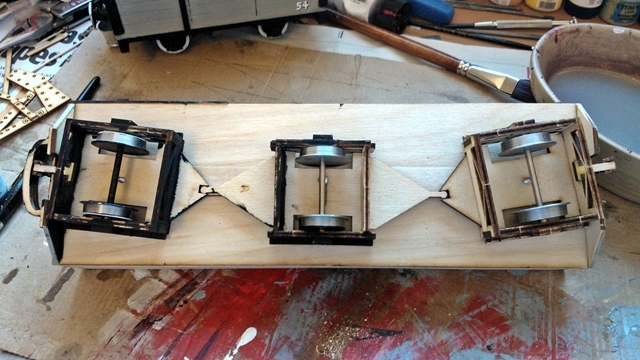
That looks to be more my style! If it can be built out of plywood, stripwood and a couple of casting then I am a happy man. I do not have much workshop space - basically just a small table and a couple of boxes of tools and bits that my wife tolerates in the house. This tends to push most of my efforts in the direction of building stock rather than tinkering with locomotives.
Si's monumental cheat would be a receipe for disaster on the SCLR. My track seems to loathe long wheelbase four-wheelers! They seem to climb the outer rail on curves without super-elevation which means they are OK on the mainline, but a total liability in stations. Otherwise with my gentle curves and well-ballasted p-way there should not have been too many problems.
Peter in AZ
Si's monumental cheat would be a receipe for disaster on the SCLR. My track seems to loathe long wheelbase four-wheelers! They seem to climb the outer rail on curves without super-elevation which means they are OK on the mainline, but a total liability in stations. Otherwise with my gentle curves and well-ballasted p-way there should not have been too many problems.
Peter in AZ
-
Annie
Now that is really clever It's only in the past few years that I've been building more of my models in wood and card and if someone had told me that a Cleminson underframe could be built entirely from wood I'd have told them that they were pulling my leg. Now that I've seen it for myself I want to give it a try too - never mind that a Cleminson 6 wheeler would have been about as rare as rocking horse pooh on a NZ tramway.
It's only in the past few years that I've been building more of my models in wood and card and if someone had told me that a Cleminson underframe could be built entirely from wood I'd have told them that they were pulling my leg. Now that I've seen it for myself I want to give it a try too - never mind that a Cleminson 6 wheeler would have been about as rare as rocking horse pooh on a NZ tramway.-
IrishPeter
Looking at the pix, I think I have it worked out. I just need to build it, and I guess a photo diary might be in order given that my Cleminson madness seems to have a following... One thing I have discovered about plywood is that for our purposes it is an underrated material. We do not operate under the sort of loads where it will wear excessively, so it becomes a very useful material once one looks anew at it. Some of the kit manufacturers - e.g. IP Engineering - have seen a potential in plywood not previously exploited and have raised its profile in the hobby. That aso helps the ret of us by saying 'hey, this works...". I am generally anti inovation, but if it works I am pretty open minded.
Peter in AZ
Peter in AZ
-
IrishPeter
I am sort of on the opposite angle to you when it comes to the Cleminson underframe. The Irish NG lines which veered more to the railway end of the railway-tramway continuum tended to be fairly free with them. The West Clare, the Swilly, the Donegal, Ballycastle, and ballymena and Larne Railways all had their little fleet of Cleminsons and they seem to have been quite popular with the travelling public.Annie:75537 wrote:Now that is really clever :D It's only in the past few years that I've been building more of my models in wood and card and if someone had told me that a Cleminson underframe could be built entirely from wood I'd have told them that they were pulling my leg. Now that I've seen it for myself I want to give it a try too - never mind that a Cleminson 6 wheeler would have been about as rare as rocking horse pooh on a NZ tramway.
Now that the Skebawn and Castleknox is no longer 'tied to the roadside, i.e. the garden path, but makes its own way across most of the yard it is taking a slightly more 'railway' character. Its opening date in the late 1880s puts it right in the middle of the Cleminson era, besides which they were cheaper than bogie coaches, but had a similar carrying capacity.
Interestingly enough, with the weight distribution in a Cleminson, although the frames were lighter than those of a bogie coach because they were supported in the middle they did not go Banana shaped like wooden framed bogie coaches. Bob Hendry noted that even after 60 years use and 25 years on "Harry Cubbon's Wing" the MNR 1879 examples were still straight, but the IMR's wooden framed bogie coaches were distinctly banana shaped inspite of their very heavy members! In some cases on the bogie coaches the washers on the tie rods were nearly through the head stocks!
Peter in AZ
-
Annie
I must be getting old Peter, my memory's failing me 
We did have Cleminson 6 wheelers here in NZ, it was just that by the time I started looking hard at trains as a youngster they'd all been converted into bogie carriages by joining half a six wheeler body to a whole six wheeler body.
And there is a survivor, C 472 became a departmental vehicle retaining its six wheel underframe, - and it even managed to get itself a set of roller bearing axleboxes which are still in place post-restoration.


Second class interior view.

First class interior view.

So now I can build myself a Cleminson coach Peter and get to know all the joys of trying to keep one on the rails.
I'm certain that I will have a drawing amongst all my old folders I've got stashed away in a box in the garage. And while I'm about it I can hunt out a drawing for a D class four wheel coach as well

Thanks for the background information on Cleminsons on the IMR and the Irish lines Peter. Interestingly as built C 472 would've had window spacings similar to the little D class four wheeler (also a rare survivor), but towards the end of their existance as six wheelers they were rebuilt and windows were removed in order to strengthen the bodyshells.
We did have Cleminson 6 wheelers here in NZ, it was just that by the time I started looking hard at trains as a youngster they'd all been converted into bogie carriages by joining half a six wheeler body to a whole six wheeler body.
And there is a survivor, C 472 became a departmental vehicle retaining its six wheel underframe, - and it even managed to get itself a set of roller bearing axleboxes which are still in place post-restoration.
Second class interior view.
First class interior view.
So now I can build myself a Cleminson coach Peter and get to know all the joys of trying to keep one on the rails.
I'm certain that I will have a drawing amongst all my old folders I've got stashed away in a box in the garage. And while I'm about it I can hunt out a drawing for a D class four wheel coach as well
Thanks for the background information on Cleminsons on the IMR and the Irish lines Peter. Interestingly as built C 472 would've had window spacings similar to the little D class four wheeler (also a rare survivor), but towards the end of their existance as six wheelers they were rebuilt and windows were removed in order to strengthen the bodyshells.
-
IrishPeter
I would have been surprised if there had not been Cleminsons in NZ. I seem to remember you had quite an influx of Scotsmen at one time, and they seemed to take their pet inventions with them.
The little D class four-wheeler looks like a larger version of the Schull and Skibbereen Railway's Dick, Kerr vehicles, even down to the handrails on the balcony. I would assume they date to the early 1870s, whilst the Cleminsons were late-70s and 1880s
I think the C-class six wheelers in original condition would have looked somewhat like a grown up version of the Southwold Railway's Cleminson saloons, but slightly more conventionally British looking. The Southwold examples had toplights, which coupled with the saloon format made them look more North American than British.
The interiors remind me of the minor Irish lines. Indeed with the seats, varnished walls, white ceiling, and 'fishbowl' lights it could have been the Isle of Man Railway carriage I was riding in at the end of the last month, but for the fact the IMR is largely a compartment stock line, or a Manx Electric "tunnel car." except they have clerestories. The IMR saloons - F29-32 and 35/6 are seated in the American Interurban tradition with transverse reversible seats rather than the benches favoured in Ireland.
The thing you have to remember with Cleminsons is that they are less tolerant of out and out bad track than bogie stock. Provided you keep it relative free of dropped joints and weird horizontal misalignments you should be OK. The Achilles heel of the Cleminson design so far as the Isle of Man Railway was concerned was the wooden centres of the Maunsell wheels on the middle truck collapsing on tight bends. Not a problem we usually have in SM and SE scales.
Yours,
Peter in AZ
The little D class four-wheeler looks like a larger version of the Schull and Skibbereen Railway's Dick, Kerr vehicles, even down to the handrails on the balcony. I would assume they date to the early 1870s, whilst the Cleminsons were late-70s and 1880s
I think the C-class six wheelers in original condition would have looked somewhat like a grown up version of the Southwold Railway's Cleminson saloons, but slightly more conventionally British looking. The Southwold examples had toplights, which coupled with the saloon format made them look more North American than British.
The interiors remind me of the minor Irish lines. Indeed with the seats, varnished walls, white ceiling, and 'fishbowl' lights it could have been the Isle of Man Railway carriage I was riding in at the end of the last month, but for the fact the IMR is largely a compartment stock line, or a Manx Electric "tunnel car." except they have clerestories. The IMR saloons - F29-32 and 35/6 are seated in the American Interurban tradition with transverse reversible seats rather than the benches favoured in Ireland.
The thing you have to remember with Cleminsons is that they are less tolerant of out and out bad track than bogie stock. Provided you keep it relative free of dropped joints and weird horizontal misalignments you should be OK. The Achilles heel of the Cleminson design so far as the Isle of Man Railway was concerned was the wooden centres of the Maunsell wheels on the middle truck collapsing on tight bends. Not a problem we usually have in SM and SE scales.
Yours,
Peter in AZ
Last edited by IrishPeter on Sun Oct 07, 2012 4:25 am, edited 1 time in total.
-
Annie
Here's a side view of D 26 Peter. Built 1874 by the Railway Carriage Co.
The Cleminson carriage C 472 is by the same builder with a build date of 1879. Another surviving body only C class (275) was built in 1881 and one other (169) which is now a dwelling house was built in 1877.

The Railway Enthusiast Society here in New Zealand have gone to a great deal of trouble to track down every surviving passenger carriage in the country even if it's just a bundle of rotten sticks in a field. To my great surprise there are only 3 of these little D class carriages left, this one, another under restoration and a body only in storage. All of them were in poor condition when found so we came so close to missing out it wasn't funny.
Just on a side note and not meaning to hi-jack the thread, the society rolling stock register includes carriages converted into dwelling houses and this one quite took my fancy. Made from half of A 600 (build date uncertain) I thought I might base a model on it for the Kotanga Tramway. A house built from the other half of the carriage is also in the same district, but it's nothing like so appealing.

Thanks again for the additional information. 19th Century carriage design is really fascinating.
The Cleminson carriage C 472 is by the same builder with a build date of 1879. Another surviving body only C class (275) was built in 1881 and one other (169) which is now a dwelling house was built in 1877.
The Railway Enthusiast Society here in New Zealand have gone to a great deal of trouble to track down every surviving passenger carriage in the country even if it's just a bundle of rotten sticks in a field. To my great surprise there are only 3 of these little D class carriages left, this one, another under restoration and a body only in storage. All of them were in poor condition when found so we came so close to missing out it wasn't funny.
Just on a side note and not meaning to hi-jack the thread, the society rolling stock register includes carriages converted into dwelling houses and this one quite took my fancy. Made from half of A 600 (build date uncertain) I thought I might base a model on it for the Kotanga Tramway. A house built from the other half of the carriage is also in the same district, but it's nothing like so appealing.
Thanks again for the additional information. 19th Century carriage design is really fascinating.
Who is online
Users browsing this forum: No registered users and 3 guests