Page 1 of 1
Base for Rad 1 curves
Posted: Wed Jun 10, 2026 5:55 pm
by Wet Woking Neil
Before I start hacking up bits of wood, is there anything that is the ideal track base l for rad 1 curves and or other radii curves. Initial thought is series of small plywood blocks maybe 2' x 1' with potential 20-30° wedge ends. Alternative maybe an open PVC frame. Or is there non wood Alternatives? Any suggestions/recommendations appreciated.
Thanks
Neiĺ
Re: Base for Rad 1 curves
Posted: Wed Jun 10, 2026 9:56 pm
by GAP
Wet Woking Neil wrote: Wed Jun 10, 2026 5:55 pm
Before I start hacking up bits of wood, is there anything that is the ideal track base l for rad 1 curves and or other radii curves. Initial thought is series of small plywood blocks maybe 2' x 1' with potential 20-30° wedge ends. Alternative maybe an open PVC frame. Or is there non wood Alternatives? Any suggestions/recommendations appreciated.
Thanks
Neiĺ
On the ground or elevated?
Re: Base for Rad 1 curves
Posted: Wed Jun 10, 2026 10:56 pm
by Wet Woking Neil
GAP wrote: Wed Jun 10, 2026 9:56 pm
Wet Woking Neil wrote: Wed Jun 10, 2026 5:55 pm
Before I start hacking up bits of wood, is there anything that is the ideal track base l for rad 1 curves and or other radii curves. Initial thought is series of small plywood blocks maybe 2' x 1' with potential 20-30° wedge ends. Alternative maybe an open PVC frame. Or is there non wood Alternatives? Any suggestions/recommendations appreciated.
Thanks
Neiĺ
On the ground or elevated?
Elevated, ideally around waist height, although not decided how yet. Plan was on breeze blocks to allow change with initial setup, but housing manager (wife) has banned them.
Re: Base for Rad 1 curves
Posted: Thu Jun 11, 2026 9:24 am
by BryanW
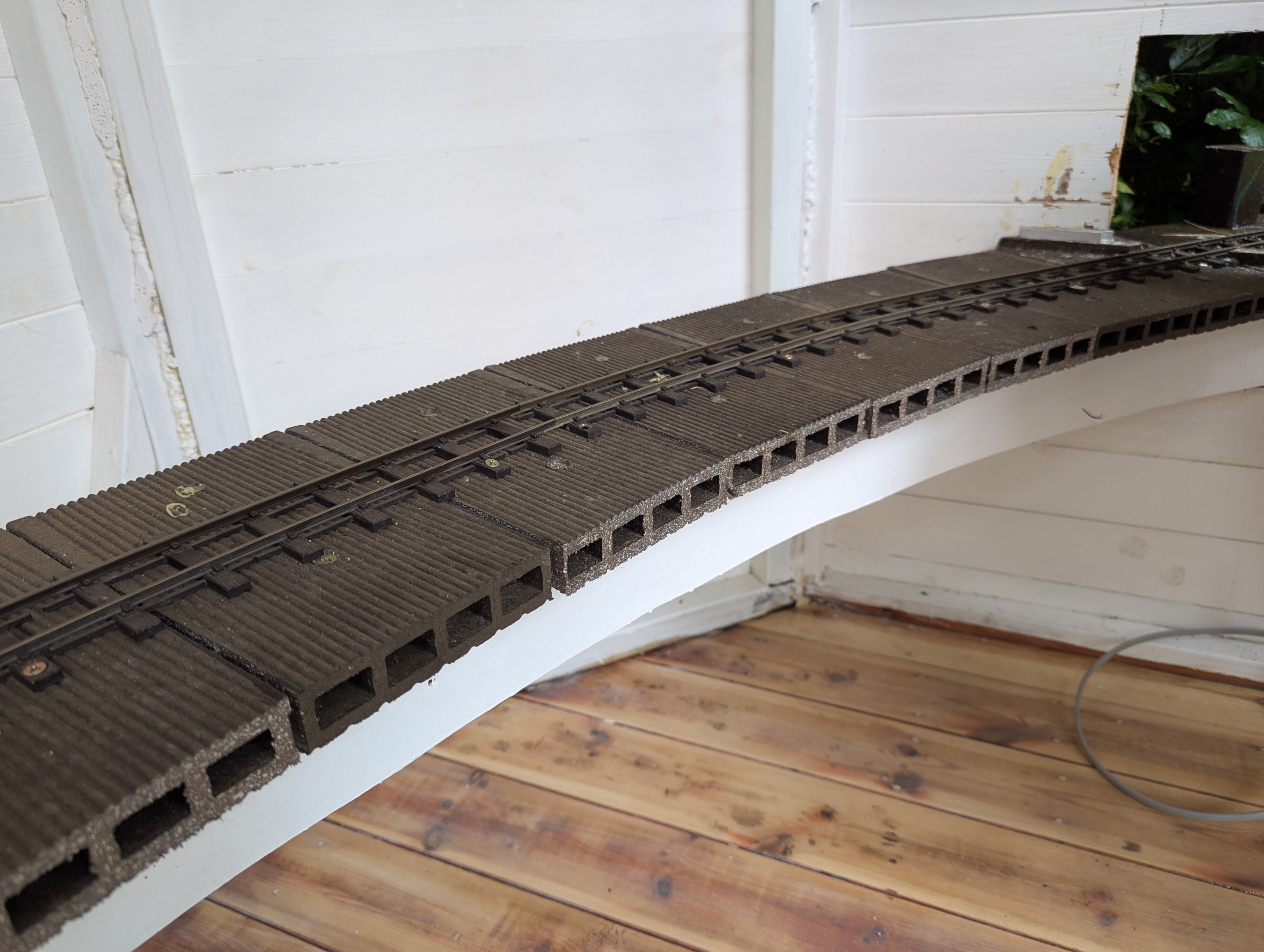
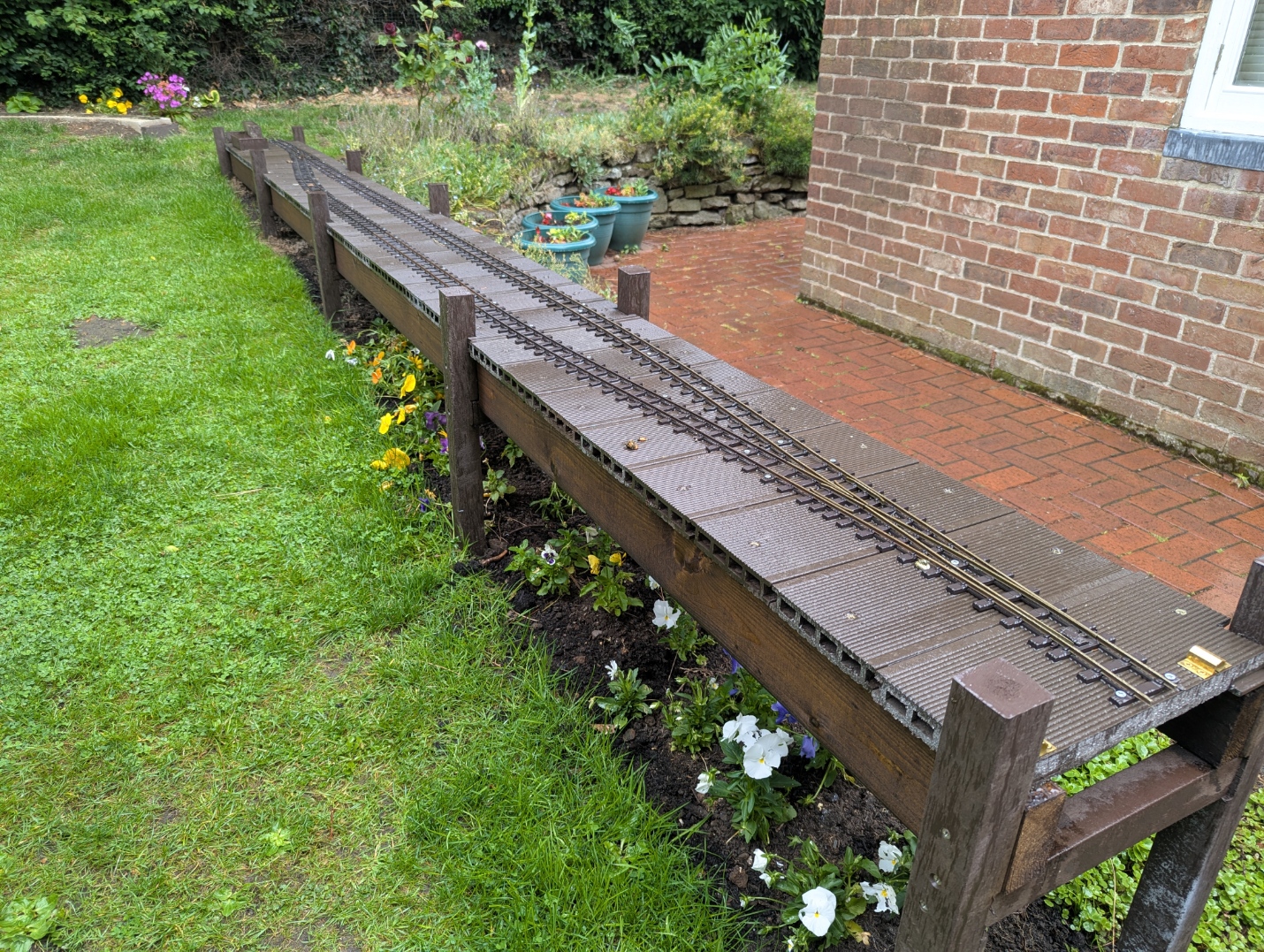
This is my solution. I re-used some plastic(?) decking boards taken up from a koi pond that had become too much. You can see that I have used the boards across the width rather than longitudinally. This is because their one weakness is a lack of structural strength - they need a lot of support underneath to prevent sagging. The section running through the station building (a.k.a. summerhouse) is constructed on a bent ply structure. Outdoors the boards run on well creosoted (modern equivalent) timbers held off the ground by 50mm by 50mm plastic posts - again from the old decking. You are unlikely to have some old plastic decking hanging around but this came from a builders merchants - Travis Perkins I think. I certainly did not pay Filcris prices!
Hope this helps.
- PXL_20260611_081310711.jpg (1.21 MiB) Viewed 8761 times
- PXL_20260611_081333188.jpg (1.11 MiB) Viewed 8761 times
Re: Base for Rad 1 curves
Posted: Thu Jun 11, 2026 10:57 am
by philipy
Wet Woking Neil wrote: Wed Jun 10, 2026 5:55 pm
Before I start hacking up bits of wood, is there anything that is the ideal track base l for rad 1 curves and or other radii curves. Initial thought is series of small plywood blocks maybe 2' x 1' with potential 20-30° wedge ends. Alternative maybe an open PVC frame. Or is there non wood Alternatives? Any suggestions/recommendations appreciated.
Plastic in some form is probably the best bet, although people do report problems with Filcris deforming, so be careful. Do a search on here for Filcris and you will find various experiences reported.
Using plywood outdoors is a recipe for disaster and small 1'x2' blocks means the tsunami will hit faster and harder, I'm afraid. Plywood of any variety will delaminate and the smaller the pieces the less resistance there is to the layers being able to lift up. If you must use timber, make sure it is treated ( decking boards or similar) and make the sections as long as possible to reduce the number of cut ends, then slosh wood preserver on it, cover with roofing felt and cross your fingers.
Re: Base for Rad 1 curves
Posted: Thu Jun 11, 2026 11:26 am
by Phil.P
If you use plastics (of some sort) across the formation, you don't need to cut it to follow the curve. - You leave the outer-edge gaps bigger. You also have almost no problem with thermal expansion of the plastics.
You can still use a layer of roofing felt, should you prefer that aesthetic?
If you can source it from someone having gutters replaced.. The plastic downpipe (round or square) makes a rot-proof vertical support.
Phil.P
Re: Base for Rad 1 curves
Posted: Thu Jun 11, 2026 10:13 pm
by GAP
Wet Woking Neil wrote: Wed Jun 10, 2026 10:56 pm
GAP wrote: Wed Jun 10, 2026 9:56 pm
Wet Woking Neil wrote: Wed Jun 10, 2026 5:55 pm
Before I start hacking up bits of wood, is there anything that is the ideal track base l for rad 1 curves and or other radii curves. Initial thought is series of small plywood blocks maybe 2' x 1' with potential 20-30° wedge ends. Alternative maybe an open PVC frame. Or is there non wood Alternatives? Any suggestions/recommendations appreciated.
Thanks
Neiĺ
On the ground or elevated?
Elevated, ideally around waist height, although not decided how yet. Plan was on breeze blocks to allow change with initial setup, but housing manager (wife) has banned them.
How I did mine one on a "table" with a fibre cement sheet op and the other on cable tray on posts.
https://ringbalin-light-railway.blogspo ... cross.html
https://ringbalin-light-railway.blogspo ... -farm.html
https://ringbalin-light-railway.blogspo ... -farm.html
Re: Base for Rad 1 curves
Posted: Thu Jun 18, 2026 4:05 pm
by Wet Woking Neil
Latest thought is my local Wicks sell NoMorePly XPS Insulation boards, 1200×600×10mm. Not very thick but feel sturdy. Cover with dark green roofing felt lining rolls, also sold at my local Wicks.