
These are the first passenger cars I've built in this scale and could well be the last. These three models were a real saga and fought me all the way.
The pass car design is loosely based on the smaller Tralee & Dingle carriages from Ireland, with some modifications to make them more Australian. The colour scheme chosen is one used by the VR for suburban electric trains from the early '30s through to the mid-'50s. The SAR-SAS used something similar in more recent years.
Construction is a polystyrene body, mounted on a wooden underframe with US style bogies. The VR used equalised US type bogies under most broad gauge pass cars and also under some of the narrow gauge ones, as they rode better on less than perfect track.
I built three cars, a first-second car and two second with van cars. These will run as a three car set with a van at each end so the train will not need to be shunted, or the van turned at each end of a run. This was standard VR suburban practice for fast turnaround, but less common on country trains and rare on the narrow gauge.
This pic shows the basic underframe, with truss rods built up from bits of K&S rod and tube, with LGB bogies and Accucraft couplers fitted. This was before I decided these would be completed as gas lit cars, so the pintsch gas tanks hadn't been fitted when this was taken.

This pic shows an assembled first-second class car body sitting on the underframe, with the seats sitting in place, but not attached. The sides are my usual three layers, with recesses on the inside for the window material and with the beading built up using Evergreen strip. The seats were built up using homemade wood mouldings for the cushions and plywood frames. First class has head and armrests, while second class is more basic and the seating is 2+1.

This is the same car fully assembled, but unpainted.

This is a second class with van body showing the interior, with the same seating arrangement in the second class compartment and a combined guard and van compartment. There is no interior in the van, as it can't be seen once the roof and windows are in position.

A second class with van car, again fully assembled but unpainted.

The sun finally appeared this afternoon and this pic shows the first-second car completed, painted and assembled, ready to enter service.
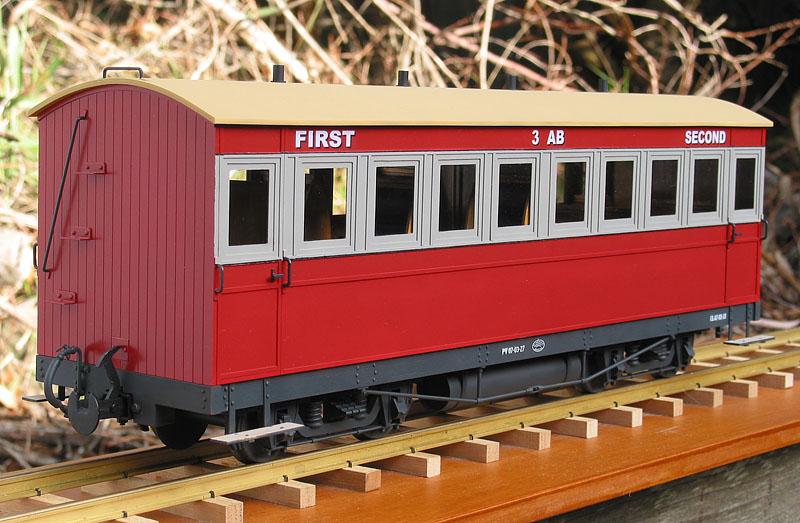
This is one of the second class with van cars as completed. The other one is the same except that it was built as a mirror image, which was another quirk of some VR built passenger cars.

My photo track isn't long enough to show all three cars, but here are two of them to give the idea. A standard TVT passenger train would have a van at each end, with extra cars added in the middle as needed. The white disc on the van end is a taildisc. The VR used these on the rear vehicle of a train during daylight to show railway staff that the train was complete. At night a red tail light would replace it.

Construction Methods
The roof on these cars was too long for my usual method of forming a polystyrene sheet roof, so I made a wooden former and laminated three pieces of 0.020" sheet to form the roof. Three layers was enough to give a rigid roof that held it's shape without extra bracing after the glue dried. The pictures show the arrangement.


The grill in the van doors was soldered up out of brass wire and strip. These were drawn on an old tile with pencil and the parts held in place with kapton tape and Blu-tack, which isn't as heat resistant as the tape, but keeps parts in place if you are quick. The photo shows a soldered grill still in place on the tile.

TVT Story
When first opened the TVT was like the early VR narrow gauge lines, with only only second class passenger accommodation. The local squattocracy soon objected to themselves and their womenfolk having to rub shoulders with the working classes, so the second class cars were divided into two compartments and one compartment was fitted out for first class.
Also at that time the guard and parcels travelled in 4 wheel vans, which were also used on goods trains. After WW1 the area was opened up to soldier settlement and the number of first class passengers reduced, but the van goods and mail loading increased. The guards also complained about the riding of the vans at passenger speeds.
The engineer accordingly had the first class compartment of a couple of the first-second class cars stripped out and rebuilt as a van compartment, as well as space for the guard. This increased van storage on mixed and passenger trains and reduced the total train weight, as the 4 wheel vans were no longer needed.
The passenger vans rode much better and the guards thought they were onto a good thing, until winter arrived. What they had forgotten was that the old vans had a stove as they were also used on goods trains, some of which could run at night. TVT mixed and passenger trains only ran during the day, so the management saw no reason to fit a stove for the guard in the rebuilt passenger cars. Especially as the paying passengers only got footwarmers as a source of heat in winter.............
Regards,
Graeme