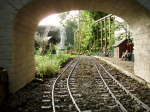
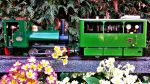
You could be forgiven for thinking that this venue was very popular with the long queues, but this is us waiting to get back in after the Fire Alarm went off just before midday. It did go off a couple more times in the afternoon but was gagged before Scottish Fire & Rescue attended again!
The layout has been built to the original 16mm spec which had a lower operating height, so that it can still be operated by wheelchair/mobility scooter bound operators (the Group has one such member with a 2nd member occasionally requiring a wheelchair). Currently the modular layout is a long straight until some members build the corner sections.

The fiddle yard
Note the extended R/C aerial sticking out into the public side of the layout as the operator is coupling up his loco having run round the stock. I took a turn at yard shunter here to avoid this situation (uncoupling/coupling the stock, and operating the traverser for the R/C operators) and also did it when I was the signaller there. But that was not always convenient when another train was asking for the Line Clear signal from the other end.

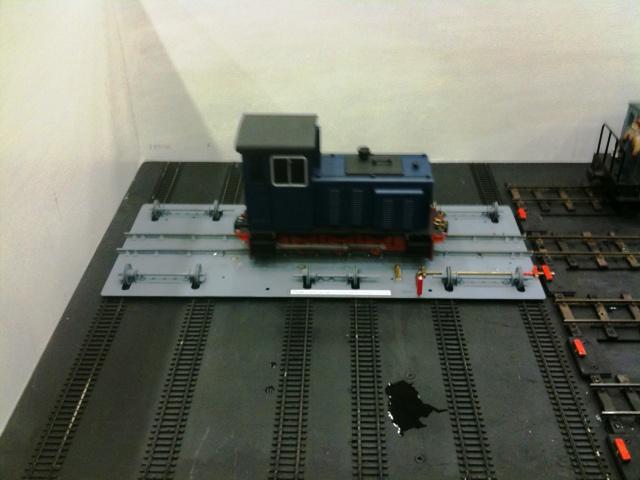
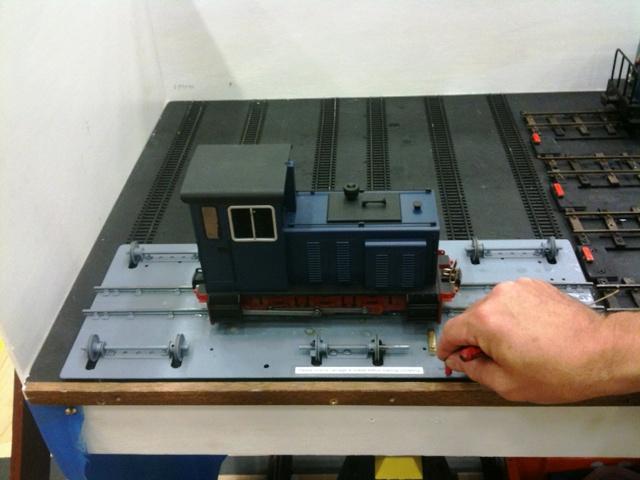
At one end there is a 3 sided walled-in 4 road fiddle yard with a beautifully constructed traverser at the end. This has been made from a recycled redundant trackside sign, with Tenmille rail chairs & rail, Meccano pulleys, axles & brackets, which smoothly running along the OO gauge track beneath, and has a manually operated lock.
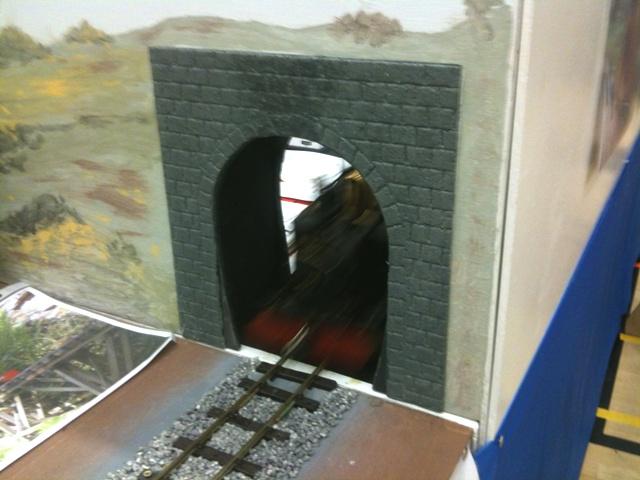
The arched exit/entrance to the fiddle yard

The intermediate halt which was not used by many passenger trains
From here the track goes through modules with an intermediate halt built on S curves. This was to cause gauging problems with Accucraft IOM 4 wheel coaches. The scenery panels were lifted out of there mounting holes to allow those coaches to run, but at some point during the day someone (probably the somewhat fussy owner of the modules) had replaced the scenery back into their holes with the result that the Ragleth pulling those IOM coaches ground to a halt with those coaches firmly stuck.
Next down the line is an intermediate siding, being used to store extra stock, and then the line continues into the end modules with a 2 road island platform station, an avoiding line with 2 storage sidings, and those 3 lines terminate at a turntable (manually operated), again built from a recycled redundant sign.
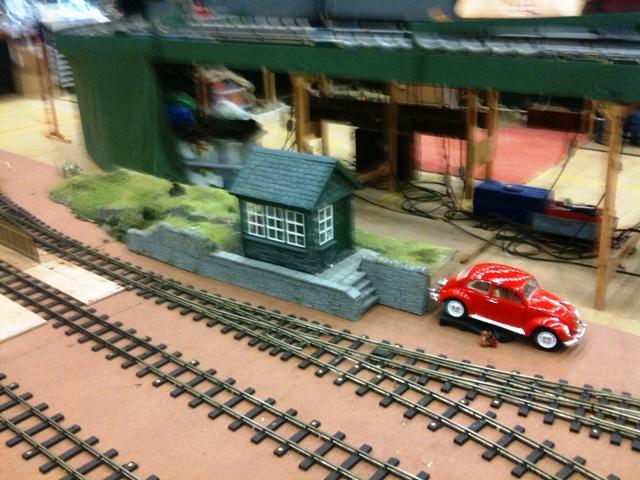
The signal box controlling the station area (the newly installed HGLW trackside fencing just appears centre left edge)

One of the station storage sidings
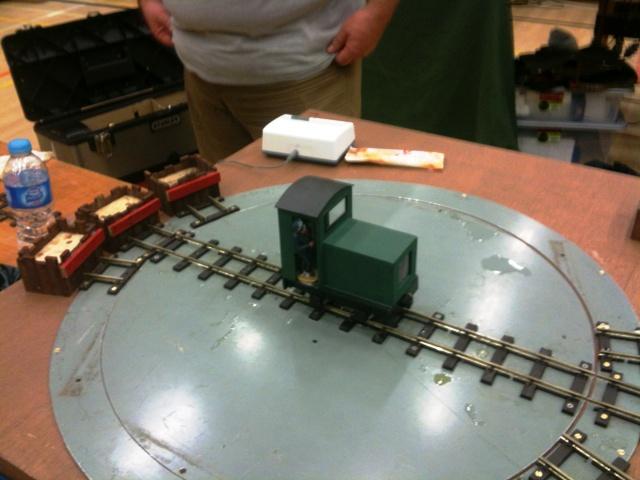
The turntable
To allow continuous running throughout the show the layout had an allocated slot booking system (max 2 steam locos at any time), and operated a buzzer ‘bell’ signal system, at least when there were 2 signallers (1 available at each end). Otherwise it was down to the ‘One loco in steam’ or anything goes rule. All locomotives (Steam & Battery) running were Radio Control except for one manual steam locomotive. Several of the steam locomotives were Roundhouse, with 3 different vintage Lady Anne’s. However it was good to compare notes with a fellow Accucraft Ragleth operator, particularly seeing how little he opened the regulator with Radio Control on the reverser, plus it had an R/C controlled DJB Eng whistle which sounded good when the pressure was up.
At the far end of the layout beyond the station modules was another table where 2 loose panels of track were being used to store after running/prepare for next run steam locomotives.
David Hippey (www.hglw.co.uk) arrived in the afternoon and brought some of his latest project to enhance the layout – laser cut trackside & station fencing.
The Group managed to attract a couple of potential new members.
A very enjoyable day out running & talking live steam finished off with a train ride southbound into a nice sunset.
Chris Cairns
(edit - forgot Group in Subject title)