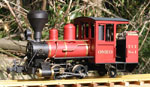
Cleaning Roundhouse Sight glass/Water gauge

Discussion of Live Steam locomotives should be located here
Post Reply
gilfachphil
Fireman
Fireman
Posts: 427
Joined: Sun Nov 24, 2019 11:00 am
Location: West Wales

Cleaning Roundhouse Sight glass/Water gauge

Post by gilfachphil » Fri Oct 17, 2025 5:06 pm

Having purchased my various live steam locos secondhand both of my Roundhouse locos (Silver Lady and Leak & Manifold) suffered from clouded water gauges due to sedimentation from water that was obviously too hard.

Searching the forum for descaling advice I bought some white vinegar I subjected the Silver Lady to filling with vinegar for a few minutes. The glass appeared to clear a bit so I removed the vinegar and rinsed out the boiler with water following which I filled it and replaced the water filler and then pumped in some more from the top-up bottle to pressurise the system a bit. I got to about 40psi before water sprayed from the safety valve. The pressure dropped rapidly and it was seen that water was leaking from the bottom of the gauge.

Email to Roundhouse asking for a replacement gasket, not heard back yet - wonder if the factory is on holiday or something. I decided to investigate so removed cab and tanks, which is easy on this loco and got into the gauge.

The gasket is an O 'ring' of sorts:-
IMG_5540.jpeg
IMG_5540.jpeg (324.89 KiB) Viewed 18912 times
This is situated underneath the glass in a recess in the body of the gauge. I could then clean out the residue mechanically.

Yesterday afternoon I decided, having re-read the descaling topics to have a go at the L&M. This time I decided to risk heating the water/vinegar mix in the boiler to boiling and leave for a few minutes. The sight glass did seem to clear but the residue in the gauge did not dissolve and I could not see water in the gauge. I removed the water/vinegar mix into a pyrex jug, these was a tiny amount of solid material and the liquid had a slight blue tinge, obviously from some dissolved copper compounds. I then rinsed the boiler a couple of times and filled it, I then pressurised it cold, as above and could see water enter the gauge, but only when it was pressurised. On emptying the boiler the gauge did not empty and a bubble of air could be seen moving up and down as I tilted the loco. The tubes to the gauge from the boiler needed clearing.

To get at the gauge it is necessary to remove some of the body work. I had hoped removing the cab would be enough but the side tank hides access to the gauge. I did not succeed in getting the cab off but could loosen it enough to make it possible to remove the left hand tank. There are machine screws at the front of the cab on either side of the boiler and two more at the back corners underneath. Removing these loosens the cab but the vacuum pipe locates in a hole at the bottom of the cab backsheet. A bolt secures the vac pipe to the chassis, underneath the coupling/buffer! Removal of the latter allowed access to the nut - just - which I unscrewed enough to allow the vac pipe to be disengaged from the cab backsheet. The cab still won't lift off because it has lugs, which can slide, holding it to the side tanks and the gas tank seems atached to the cab. I eventually realised the two pegs which hold the coal load in place are threaded and screw onto bolts fixed to the gas tank:-
IMG_5545.jpeg
IMG_5545.jpeg (962.57 KiB) Viewed 18912 times
I could only get one of these off, the other seems to have the bolt turning freely.

On this side of the loco the tank is held by one machine screw towards the front and a nut on a threaded rod at the back, plus the lugs on the cab sides. The tank is removable with care so now one can fairly easily get at seven of the eight machine screws holding the metal plate to the front of the water gauge!

Once all of the screws are out the faceplate and glass are removed and the gasket can be freed with a thin implement. The picture shows the result after cleaning:-
IMG_5541.jpeg
IMG_5541.jpeg (2.47 MiB) Viewed 18912 times
The residue was cleaned from the recess with a clean cloth. I attacked the holes with tiny cylindrical brushes designed for cleaning airbrushes and pipe cleaners, the lower hole where there was nearly all of the sediment took most cleaning. I lastly used the top-up bottle to spray water though the holes.
to be continued in the next post...

gilfachphil
Fireman
Fireman
Posts: 427
Joined: Sun Nov 24, 2019 11:00 am
Location: West Wales

Re: Cleaning Roundhouse Sight glass/Water gauge

Post by gilfachphil » Fri Oct 17, 2025 5:19 pm

continuing from the previous post:-
IMG_5542.jpeg
IMG_5542.jpeg (2.24 MiB) Viewed 18909 times
This picture shows a side view of the water gauge. the metal work is in two parts, one fixed to the side of the boiler with the front part of the gauge screwed to that. It can be seen that there has been a historic leak leading to a build up of salts around the lower joint. There must be a bend in the holes where the two pieces of metal meet, I guess, because the brushes and pipe cleaner would not go in far. I was not going to risk removing the gauge from the piece of copper fixed to the boiler as I have no way of ensuring a seal on replacement.

I cleaned the glass as well as possible soaking in vinegar, there is a thin layer of residue that would not dissolve and I was not brave enough to try using a sharp blade to scape it off, I may have scratched the glass.

The gasket in this case is thicker than the Silver Lady one, this having a diameter of about 1.3mm whereas hers is only about 0.8mm. She is much older.

I then reassembled the gauge and tightened the screws, bravely or foolishly I also put the side tank and cab back before testing anything. However when I put some water into the boiler it came into the sight glass, phew:-
IMG_5544.jpeg
IMG_5544.jpeg (2.02 MiB) Viewed 18909 times
You may make out some tissue on the cab floor, which I have left there overnight to check for leaks. Fingers crossed.

This loco is only about six years old and must have been run on hard water considering the amount of deposits in the gauge and as it seems to have only had light use. I will be running it in future on ex dehumidifier water (see viewtopic.php?t=15372) which may gradually dissolve any solids remaining in the system as it has such a low TDS content. It certainly should not cause such heavy deposits in future,

Phil

User avatar
LNR
Driver
Driver
Posts: 1828
Joined: Sat Feb 27, 2016 5:26 am
Location: Melbourne, Australia

Re: Cleaning Roundhouse Sight glass/Water gauge

Post by LNR » Sat Oct 18, 2025 12:18 am

This is an interesting read Phil, I find anything to do with water gauges interesting. I had imagined on first seeing that style of gauge on a Roundhouse loco that the basis was to have water access through one large slot. Looking at your pics I am wondering why the access holes are not much larger. I have a Wilesco traction engine and I'm sure most of us know of the large "porthole" water gauge fitted to their boilers, a bit unsightly but it works very positively. If water access holes are small air bubbles and surface tension seem to make gauges somewhat unreliable. For the same reason I think banjo bolt type fittings restrict water access too much.
These are my personal feelings only and in a quest for a better gauge for my recent Fowler build, I chose to design a minimum 3/16ths diam. straight holes for water access, but found the best solution is the blow down cock on the lower fitting. Crack the cock air bubbles and water level shoot up and down and settle at the correct level.
I hope you have succeeded in fixing the leaks on your gauges, and you have given us all a better understanding of these gauge types.
Grant.

User avatar
GTB
Driver
Driver
Posts: 1690
Joined: Sat Mar 05, 2011 2:46 pm
Location: Australia

Re: Cleaning Roundhouse Sight glass/Water gauge

Post by GTB » Sat Oct 18, 2025 3:10 am

gilfachphil wrote: Fri Oct 17, 2025 5:19 pm This loco is only about six years old and must have been run on hard water considering the amount of deposits in the gauge and as it seems to have only had light use. I will be running it in future on ex dehumidifier water (see viewtopic.php?t=15372) which may gradually dissolve any solids remaining in the system as it has such a low TDS content. It certainly should not cause such heavy deposits in future,
A few points....

TDS is an acronym for total dissolved solids and is only part of the story with water purity. A TDS meter is a conductivity meter and only registers the dissolved salts in water. It doesn't register the suspended solids which are insoluble (mud, etc.).

Personally I wouldn't use dehumidifier water in a miniature boiler on a bet. It will have a low level of dissolved salts, but will contain suspended solids, ie. household dust, which includes dander, dust mites, dust mite droppings, etc. etc. Rainwater isn't any better, as it contains dissolved gases as well as solid pollutants (plus salt in coastal areas). A small water still is probably the best alternative for making reasonably pure water at home.

A lot of miniature loco owners leave the water in the boiler after a run, which means salts, insolubles and scale slowly build up. I've had two previously owned locos arrive with the lower sight glass passage plugged with white residue and a haze layer on the glass.


I don't run my locos very often, so I drain the boiler at the end of a run while it is still warm and store it dry with the filler plug removed.

Even though I use a high purity water as boiler feedwater, a white film slowly builds up on the inside of the gauge glass. The gauge glass design on those of my locos that have one is the tubular type, with a plug in the top fitting that allows the glass tube to be periodically cleaned without the glass and o-rings being disturbed. I use a small bottle brush of the type sold for cleaning airbrushes. I just dip it in clean water and give the glass a scrub, as the haze layer is easily removed.

Regards,
Graeme

ps. To clean the glass plate in a Roundhouse loco, try an old toothbrush dipped in water. It won't scratch the glass, but will remove the haze layer if it isn't too adherent.

gilfachphil
Fireman
Fireman
Posts: 427
Joined: Sun Nov 24, 2019 11:00 am
Location: West Wales

Re: Cleaning Roundhouse Sight glass/Water gauge

Post by gilfachphil » Sat Oct 18, 2025 7:42 am

On the question of water purity I reckon that starting with the lowest dissolved solids readily available is the best option. Suspended material will tend to settle to the bottom given that the container has a reasonable amount of time to stand before use. I do remove any remaining water at the end of the running session, normally with the big syringe. With the L&M loco there were black flakes in the residual water when I first got it but these have become less noticeable over the few months of my ownership and the routine I was advised to use so I hope I am doing something right!

I have not been concerned with reading the water gauge in the locos mentioned as there has always been water left in the boiler when the gas runs out (so far) and my instructor taught me to allow the loco to cool and do a full service before firing again.

With a cleaner water gauge than before time will show whether my routine is better than that of the previous owner,

Phil

User avatar
Old Man Aaron
Driver
Driver
Posts: 1124
Joined: Wed Oct 19, 2016 11:08 am
Location: Sunshine Coast QLD, Australia

Re: Cleaning Roundhouse Sight glass/Water gauge

Post by Old Man Aaron » Mon Oct 20, 2025 1:46 pm

I do like the simplicity of these "machined lump" RH gauges.

Though like you, I pay no mind to that fitted to my Bundy, when you can just withdraw 30ml after brimming the boiler, and trust the gas tank's calibrated capacity.
Regards,
Aaron - Scum Class Works

gilfachphil
Fireman
Fireman
Posts: 427
Joined: Sun Nov 24, 2019 11:00 am
Location: West Wales

Re: Cleaning Roundhouse Sight glass/Water gauge

Post by gilfachphil » Thu Oct 23, 2025 6:56 am

I was sure I had already posted:-

On Saturday morning I steamed the L&M, no leaks could be seen around the water gauge and during the run I could see the water level in the sight glass clearly and note a gradual decrease in level.

Success!

Phil

gilfachphil
Fireman
Fireman
Posts: 427
Joined: Sun Nov 24, 2019 11:00 am
Location: West Wales

Re: Cleaning Roundhouse Sight glass/Water gauge

Post by gilfachphil » Sat Nov 08, 2025 8:14 pm

To complete (fingers crossed) the tale, I eventually phoned Roundhouse and spoke to a helpful man saying I wanted to order a new gasket for my Silver Lady water gauge. He said they had used three different sizes over the years and he would send me one of each free of charge. When they came I used a circle template to measure the outside diameter, they were 22, 23, and 24mm and one was of much thicker material than the other two. I also used the template to see what o/d the original, now oval one was and it seemed to be 23 so I fitted that one. Today the gods of weather finally aligned so I could test steam her and I’m pleased to report there were no leaks and I could see the level in the sight glass clearly.

:lol:

Phil

User avatar
Old Man Aaron
Driver
Driver
Posts: 1124
Joined: Wed Oct 19, 2016 11:08 am
Location: Sunshine Coast QLD, Australia

Re: Cleaning Roundhouse Sight glass/Water gauge

Post by Old Man Aaron » Sun Nov 09, 2025 8:33 am

Glad to hear the loco's back in steam.

Gotta love Roundhouse. 8)
Regards,
Aaron - Scum Class Works

Post Reply

Who is online

Users browsing this forum: No registered users and 2 guests