Page 1 of 2
Building scale
Posted: Wed Jan 22, 2014 7:25 pm
by SapperAnt
Hi Guys, Gals and those who identify as neither
What scale do people build their trackside structures at?
Looking at the interwebs and Garden Rail most structures seem tiny.... I've been drawing up some local buildings (based on brick counting) to 16mm scale/ 1:19 they're vast. Even the little LYR station grotty hut is mahoosive. And really bring home how small narrow gauge actually is.
So do most people tend to reduce the scale of their buildings so as not to tower over their trains (to reduce space or it is because in our heads buildings don't tower over trains...even our tiny ones).
Secondly - help! What do people use for bricks or to represent brick walls?
Ant

Posted: Wed Jan 22, 2014 8:49 pm
by andymctractor
Many of my buildings and structures are from kits and these often tend to be much closer to 1:24 than 1:19. Often these kits are sold to both 16 millers and G scalers but also, this might be done to reduce a buildings footprint and is only really noticeable if you place buildings of the different scales together. It may be more acceptable to put 1:24 stuff in the background and the close up stuff a bit closer to 1:19.
I noticed how small many of my structures are when I constructed a terrace of 4 stone cottages using jigstones to 1:19. This is a massive building and takes 2 to lift it. I daren't use it or it will show how out of scale the others are.
Eventually I might sell it at Peterborough at the member to members
stand but I don't fancy putting it in my car.
Re: Building scale
Posted: Thu Jan 23, 2014 7:40 pm
by TommyDodd
SapperAnt:95812 wrote:I've been drawing up some local buildings (based on brick counting) to 16mm scale/ 1:19 they're vast. Even the little LYR station grotty hut is mahoosive. And really bring home how small narrow gauge actually is.
You know what? I think that's probably a good thing. Many of us are drawn to narrow gauge by the appeal of the smaller, human-scale kit- friendlier and less intimidating (as Peachbottom puts it). A train alone in the garden can sometimes lose that appeal because it's out of context, with nothing visible for comparison so it loses that sense of smallness. On the mantlepiece or on plain line through the rockery a VoR 2-6-2T is a large and impressive piece of kit. It's only when it's stabled opposite an ATW 158, NR 37 or looking slightly lost among the full-size buildings at Aberystwyth that you're reminded how small it really is in "big railway" terms. Anything that cuts our trains down to size and serves as a visual clue to their overall proportion is a good thing. Buildings large or small have a role to play in this, since doors and windows are people-sized and fairly standard (with exceptions). I would say that for best effect, close to the track a smaller building of the right scale is more useful than a same-size model of a larger building in a different scale. Further away from the track there's a lot more room for manoeuvre- even "forced perspective" if you're very lucky and rather clever.
It's not just buildings either: Any familar object of known size can serve to provide an eyeball-reference for scale. Figures and human-scale objects like bicycles, suitcases, street furniture and the like, as could familiar railway equipment like standard gauge stock (on transporters, or off their wheels in retirement as sheds, shelters or whatever) or equipment like signals.*
*Yeah, signals. For me they can make or break scale effect. There were comparatively few narrow gauge railways, certainly not enough to justify manufacturers producing special signals for them, so the few lines that had them tended to buy off-the shelf kit straight from manufacturers' catalogues intended for SG lines. This means that signals appear very large in the narrow gauge world, the proportions look wrong with the arms too big (especially on short posts to be visible to drivers nearer to the ground) and the trains too small, but that's prototypical. If you freelance a signal so it "looks right" with the trains it's almost certainly wrong- but if it "looks wrong" it's more likely to be right- no wonder lots of modellers don't bother with them ;-)
Posted: Thu Jan 23, 2014 8:08 pm
by Colinjamesporter
Ive only built one building so far for the garden railway which is based on the building from Snapper Halt. It was built to 1:19 scale.
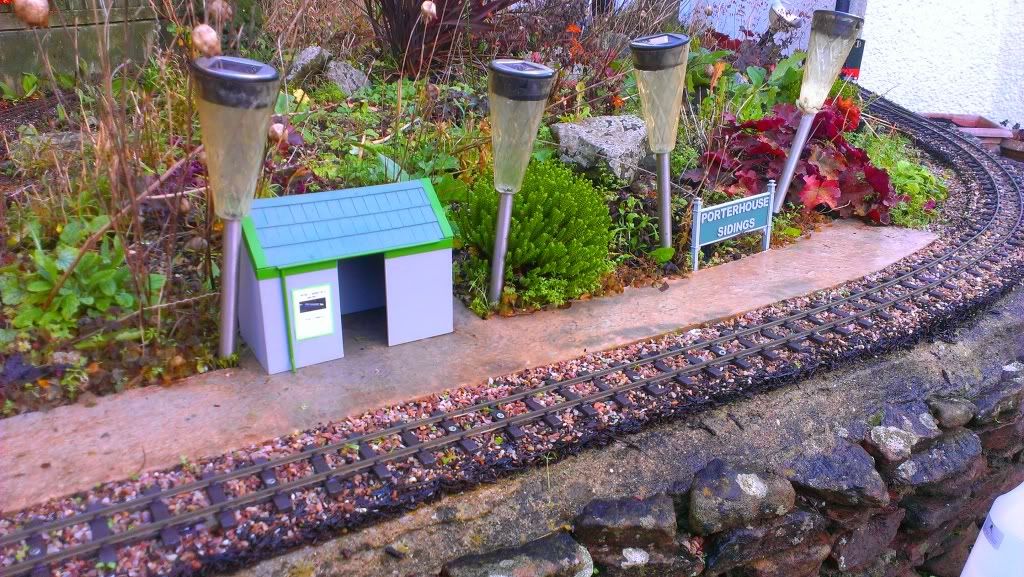
Best wishes
Colin
Posted: Thu Jan 23, 2014 8:10 pm
by Woodfields Light Railway
WhT is 1:19? Is it 16mm?
Posted: Thu Jan 23, 2014 8:22 pm
by LnBmad
1:19 is 16mm:1foot
Posted: Thu Jan 23, 2014 8:26 pm
by Woodfields Light Railway
*brain explodes*................ Oh..... Got it!!!
Posted: Sun Jan 26, 2014 12:56 pm
by bazzer42
Having been a little bit lgb in the past I am in the process of replacing buildings with true 16mm scale sizing. My modeltown figures need the headroom to get in. It will be interesting to see how the buildings appear. I have just measured up a combination of Lydney junction and Oakle Street stations on the old Severn and Wye and it scales out at 32 inches. If it looks too big I'll lose it in the flower bed at the rear of my terminus.
Posted: Sun Jan 26, 2014 1:52 pm
by philipy
bazzer42:96068 wrote:.... I have just measured up a combination of Lydney junction and Oakle Street stations on the old Severn and Wye and it scales out at 32 inches..
Doesn't surprise me. Quite by chance I've just spent this morning drawing up an old village post office and village stores, to act as part of the rear scenic break behind my station building.
The post office building is 'Listed' and dates from 1678 so you'd expect it to be small but even so, in 16mm it measures at 720mm long ( 28.5" in old money)!
Posted: Sun Jan 26, 2014 4:37 pm
by MDLR
bazzer42:96068 wrote:Having been a little bit LGB in the past I am in the process of replacing buildings with true 16mm scale sizing.
It's a good job you're saying this here and we all know what you mean: there's a story that a garden railwayer went to Uni and saw a poster for an LGB Club. "Oh, goody!" he thought, and went along to the first meeting with his latest big red box, only to discover that LGB meant something entirely different......................
Lesbian, Gay & Bisexual, if you didn't know..........

:oops: :oops:
Posted: Sun Jan 26, 2014 8:00 pm
by bazzer42
Thanks Brian, a quick search on lgb always brings up the rainbow flag. I think I'm committed to 16mm buildings having spent the weekend casting these babies in resin. After my first over loading of fillite it has worked quite well.

ps masters made using 4.8mm square plastruct to fit snugly with 5mm foamboard. The upper windows can be cut off to form plain doors, too lazy to make two masters.....
Posted: Sun Jan 26, 2014 8:51 pm
by MDLR
I used to use car filler for that job, and glass reinforced filler for roof panels.........
Posted: Mon Jan 27, 2014 7:35 am
by philipy
bazzer42:96090 wrote:
ps masters made using 4.8mm square plastruct to fit snugly with 5mm foamboard. The upper windows can be cut off to form plain doors, too lazy to make two masters.....
Bazzer,
They look superb, what did you use for the actual mould itself?
Posted: Mon Jan 27, 2014 1:31 pm
by bazzer42
Hi Philip,
RTV silicone to make the moulds. Made the masters from plasticard and plastruct and then stuck them to a sheet of plasticard for the base of a mould. Used cheap pound shop aluminium trays for the moulds. This is my first attempt at casting and quite pleased how well it has turned out. There are some tiny air bubbles but small enough to wonder whether filling is worth it. I need to make a mould tonight so will post a couple of pics as I go. Toilet windows are on the agenda.....
Posted: Mon Jan 27, 2014 4:13 pm
by Andrew
bazzer42:96131 wrote: I need to make a mould tonight so will post a couple of pics as I go.
Ooh, yes please! Learning to cast in resin's been on my "to do" list for a year or two but have never quite got my head round the process enough to order the stuff. Some buildings are on the cards sooner rather than later, my enthusiasm's been stoked up by your lovely goods shed model - some resin doors and windows would be just the thing...
Andrew.
Posted: Mon Jan 27, 2014 5:44 pm
by philipy
Thanks for that. I look forward to the pictures.
I did try some making some silicone moulds once, about 35 years ago, without much success and have been reluctant to try again, but I think I must bite the bullet.

Posted: Mon Jan 27, 2014 8:05 pm
by bazzer42
Whether I've been lucky, I don't know but the moulds have worked quite well. The latest pink moulds are Tomps fast setting and should be demouldable in 2 hours. The blue takes longer to set so may give more time for air bubbles to rise but I may have been lucky to date.
it's all a bit pound shop. A ps plastic jug to mix the silicone and catalyst in using a ps knife (4 for a pound!) and the mould is ps aluminium tray cut down and stuck together with ps contact adhesive. The scales were an invaluable buy and can be reset every time you add resins, fillers or silicones. Once you have cast an item you can gauge your mix by weight.
the window in one of the pictures took 8g each of hardener and resin and a teaspoon of fillite to give colour, and add padding. Too much fillite causes a failure to set properly....as I have found out.

original made from plastruct stuck to plasticard

Posted: Mon Jan 27, 2014 8:14 pm
by bazzer42
Mould now stuck to baking tray

the silicone and catalyst. When mixed I pour from about 2 feet above the tray to reduce air bubbles.
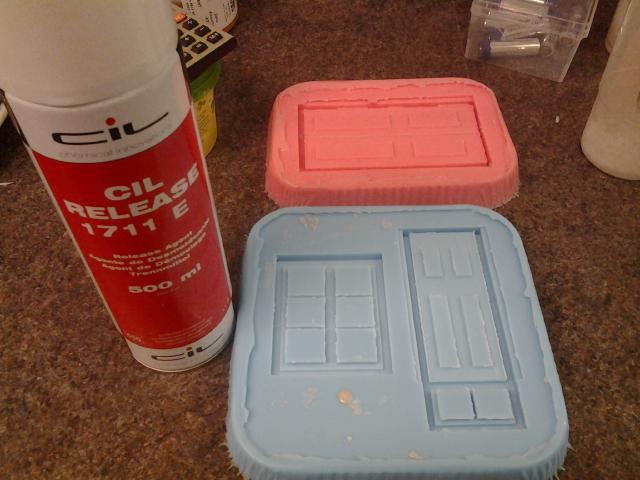
release agent and two moulds. A tiny squirt of this certainly prevents sticking, although I can't say for sure as I've yet to forget (give it time)
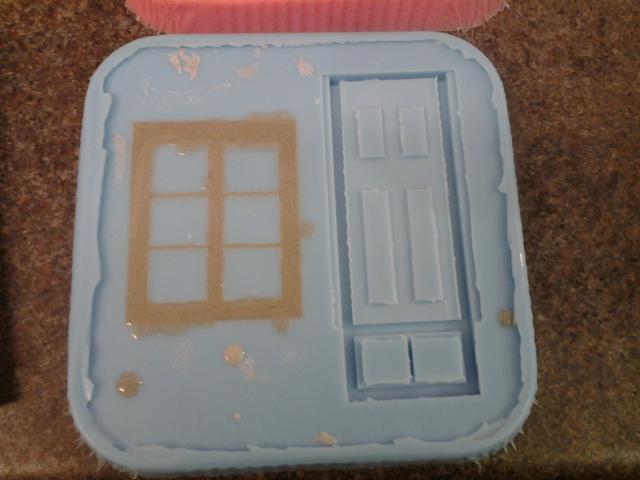
and finally the next window is setting the mould.
Posted: Mon Jan 27, 2014 8:47 pm
by philipy
Fantastic, thanks.
What size are the crossbars on the window? They look very fragile, how thin do you think you can go?
Posted: Mon Jan 27, 2014 8:59 pm
by bazzer42
philipy:96174 wrote:Fantastic, thanks.
What size are the crossbars on the window? They look very fragile, how thin do you think you can go?
sorry to hi jack the thread. The cross members are 2mm and the resin will flow unaided... standardised on 4.8mm main frame, 3.2mm inner frame and 2mm crossbars, door panels are edged with 1.5mm quadrant.