
I also ordered some dummy non-return valves for the side of the boiler, and some cab rain strips, as well as a couple of packages of hex-head bolts to replace some of the slotted-head ones standard on Roundhouse engines.
I've been "on the fence" about non-functioning dummy parts on a real steam engine, but lately I've been admiring Chris Bird's engines a lot, as well as Tag Gorton's engines in Garden Rail. So, I decided to dress my engine up a bit too.
Although I love the jaunty look of the Roundhouse Billy, there has always been something I have found odd-looking about it. Finally I've figured out what it is: It's the spindly look of the valve gear and cylinders at the front of the engine. The large cabs and tanks on Roundhouse engines tend to move the visual "center of mass" towards the back, making them look a little spidery on the front. Or so I find. Anyway, the running boards fix that for me, and the engine looks much more balanced now and dare I say, a little more "British". The nice little details seem to make the engine look much more complete as a model too. I wasn't too fussed about detail when I built it, but even the simplest rolling stock kit seems to have a bit of scale detail, and the engine now matches the wagons in that regard, having just a touch of extra detail.
The running boards are very nicely made. They come with a mechanical lubricator and little pipes on the left-hand side, and on both sides they can come with locoworks springs and lamp-irons. You can also order a Westinghouse pump for the right-hand side, but I chose not to because I haven't decided how to address the braking issue yet on my railway! I already had some cast springs stuck on the locomotive, so I removed these on the front as the locoworks ones are nicer. I left the ones on the back as the running boards for Billy only came with the front ones. The running boards are not simply stamped out of a sheet, they have a nice edging to them which is a separate piece hard-soldered on, and the workmanship is very nice. They come pre-painted, and I got the satin black with red springs. The instructions are easy to follow and the boards when installed are nice and sturdy, being held on by bolts which are already on the engine. It took about fifteen minutes to install them and it was very easy.
The little non-return valves have tabs soldered on which are simply held on the boiler by fitting the tab under a boiler band and then re-tightening the band. I had a little trouble with this because the bands over time on my engine have somehow embedded themselves into the paint. (It's a kit and the auto paint I used must not have been fully cured when I assembled the boiler) After some careful fiddling however, I got them on there.
The cab roof strips are meant to be mounted on little bolts, but I glued them with some of the same stuff I used to mount my name-plates. Well, why not. It doesn't get hot there anyway.
The bolts to replace the cheese-head screws come pre-painted. It took no time at all to swap these out, as well as the two screws that hold the front of the tanks to the frame, which I just touched up with a bit of maroon so they match the body.
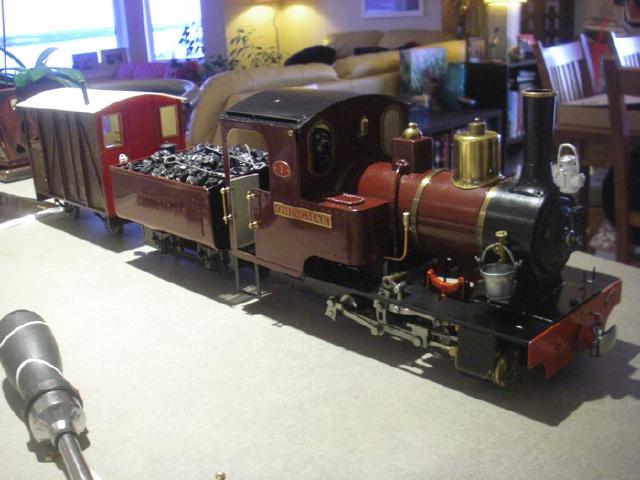
I also bought locoworks' "small firing iron" set. Since my engine has a tender I am somewhat at a loss for a place to mount them, however they look OK just sitting on the coal in the tender. These little tools come with what I assume is a chemically-blackened finish, which makes them look as though they are steel which has been subjected to the heat of a fire. Very nice. Sitting on the coal in the tender you might at first glance think my engine is coal-fired by the used look of these tools.
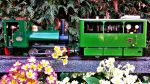
So, I can't find the cord to attach my good camera to the computer, so I will have to post these horrible pictures of the locomotive in its current state, which I took with my old one. I apologise for the bad photographs, but at least you can see the engine and I think you will agree that it looks much more fit for purpose with these details than it did previously.


In conclusion, I am very pleased with the fit and quality of these parts, and I also found Tom at locoworks to be friendly and easy to deal with, as I must say I have found with all 16mm suppliers from England. I love tinkering with my engine and dealing with the small businesses who supply the little after-market parts for it.

 the other one had been requested by Roundhouse to have a Lady Ann chimney with the copper chimney cap, that looked the business too!